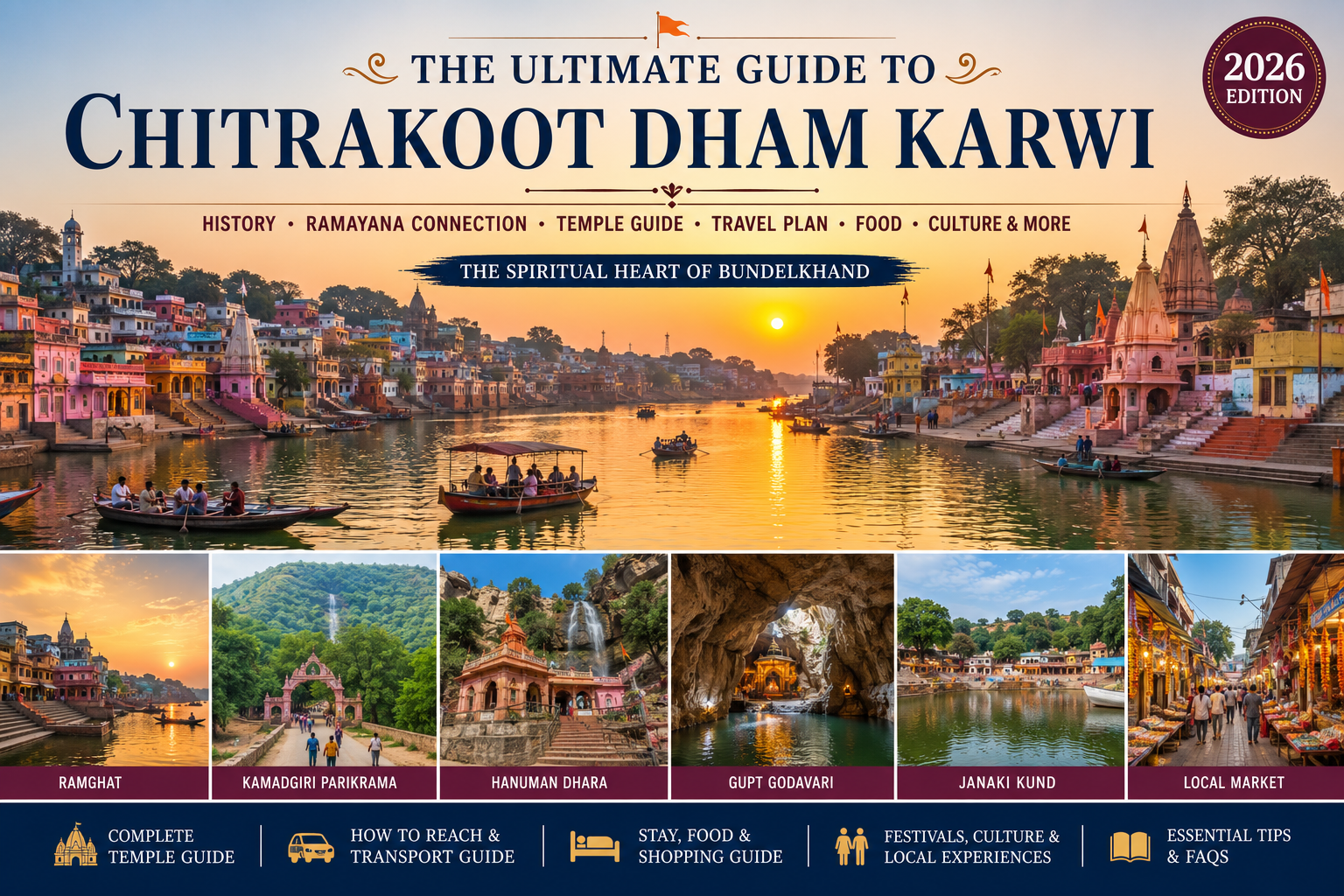
Chitrakoot Dham Karwi – The Hill of Many Wonders
History, Ramayana, Tourism, Temples, Waterfalls, Hotels, Food, Travel Guide & Everything You Need to Know
The guide will include:
- Introduction
- About Chitrakoot
- Chitrakoot at a Glance
- Why Chitrakoot is Important
- Complete Ramayana Connection
- Why Lord Rama Stayed Here
- Complete History of Chitrakoot
- Ancient History
- Mythological History
- Archaeological Importance
- Chitrakoot in Different Scriptures
- Geography
- Climate
- Demographics
- Economy
- Language
- Culture
- Festivals
- Religious Importance
- Kamadgiri
- Ramghat
- Bharat Milap
- Gupt Godavari
- Hanuman Dhara
- Sati Anusuya Ashram
- Janaki Kund
- Sphatik Shila
- Bharat Koop
- Ganesh Bagh
- Ram Darshan Museum
- Chitrakoot Waterfalls
- Nearby Attractions
- Complete Temple Guide
- Complete Travel Guide
- Rail Connectivity
- Road Connectivity
- Air Connectivity
- Best Time to Visit
- One Day Itinerary
- Two Day Itinerary
- Three Day Itinerary
- Where to Stay
- Luxury Hotels
- Mid-range Hotels
- Budget Hotels
- Dharamshalas
- Local Food Guide
- Street Food
- Famous Sweets
- Restaurants
- Shopping Guide
- Local Markets
- Souvenirs
- Safety Tips
- Photography Guide
- Wildlife Around Chitrakoot
- Monsoon Travel Guide
- Summer Travel Guide
- Winter Travel Guide
- Hidden Gems
- Offbeat Places
- Complete Distance Guide
- Important Phone Numbers
- Sample Budgets
- Suggested Itineraries
- Practical Travel Tips
- Frequently Asked Questions (100+ FAQs)
- About the Author (Dharam)
Introduction
Chitrakoot Dham Karwi – The Sacred Land Where Lord Rama Spent His Exile
When people think about the Ramayana, names like Ayodhya, Panchvati, Kishkindha, Rameswaram, and Lanka often come to mind. Yet, among all these sacred places, Chitrakoot Dham occupies a uniquely emotional and spiritual place. It is here that Lord Rama, Mata Sita, and Lakshmana spent some of the most peaceful and spiritually significant years of their 14-year exile. It is also the place where Bharat met Lord Rama and pleaded with him to return to Ayodhya—a moment regarded as one of the most emotional episodes in the Ramayana.
Today, Chitrakoot is far more than a pilgrimage destination. It is a living blend of mythology, spirituality, natural beauty, history, culture, and faith. Located on the border of Uttar Pradesh and Madhya Pradesh, Chitrakoot attracts millions of pilgrims, tourists, historians, researchers, saints, and nature lovers every year.
Whether you are planning a pilgrimage, researching Indian mythology, exploring India’s hidden heritage, or simply looking for a peaceful spiritual retreat, Chitrakoot offers an unforgettable experience.
This guide has been written to become the most comprehensive online resource about Chitrakoot Dham Karwi, covering everything from its mythology and history to travel tips, local cuisine, shopping, temples, waterfalls, hotels, and frequently asked questions.
Quick Facts About Chitrakoot Dham
| Category | Details |
|---|---|
| State | Uttar Pradesh & Madhya Pradesh |
| District | Chitrakoot (UP) & Satna (MP) |
| Headquarters | Karwi |
| Railway Station | Chitrakoot Dham Karwi |
| Famous For | Lord Rama’s Exile, Kamadgiri, Ramghat |
| River | Mandakini River |
| Main Language | Hindi, Bundeli, Awadhi |
| Best Time to Visit | October to March |
| Famous Festival | Diwali, Ram Navami, Makar Sankranti, Amavasya Mela |
| Elevation | Approx. 190 meters |
| Nearest Airport | Prayagraj & Khajuraho |
| UNESCO Status | Not yet listed |
| Religious Importance | One of India’s most sacred Ramayana pilgrimage sites |
About Chitrakoot
The word Chitrakoot comes from two Sanskrit words:
- Chitra meaning “Beautiful” or “Picturesque”
- Koot (Kut) meaning “Hill” or “Peak”
Together, Chitrakoot literally means:
“The Hill of Many Wonders”
or
“The Beautiful Hill.”
Chitrakoot is a sacred place and cultural region in central India, known as the “Hill of Many Wonders.” The word Chitrakoot symbolises spiritual richness and has deep roots in Hindu mythology and the epic Ramayana.
It spans across two Indian states — Uttar Pradesh and Madhya Pradesh — with the famed Chitrakoot Dham Karwi serving as the administrative and pilgrimage centre on the Uttar Pradesh side.
Ancient sages described this land as one of the most beautiful forests on Earth. Even today, despite urban development, the region retains its serene landscapes of hills, forests, rivers, caves, waterfalls, and temples.
Unlike many pilgrimage towns that are known primarily for grand temple architecture, Chitrakoot is revered because of the divine events believed to have occurred here. Every hill, cave, rock, and stream carries a story from the Ramayana.
Where is Chitrakoot Dham Karwi?
Many visitors become confused by the names Chitrakoot, Chitrakoot Dham, and Karwi. Here’s a simple explanation.
Karwi is the administrative headquarters of Chitrakoot district in Uttar Pradesh. The main railway station serving the region is Chitrakoot Dham Karwi, located in Karwi. The sacred sites associated with Lord Rama are spread across both Uttar Pradesh and Madhya Pradesh, connected by the Mandakini River.
In everyday conversation, people often use “Chitrakoot,” “Chitrakoot Dham,” and “Karwi” interchangeably, but they refer to slightly different aspects of the same destination.
| Name | Meaning |
| Chitrakoot | The sacred geographical and historical region |
| Chitrakoot Dham | The pilgrimage destination associated with Lord Rama |
| Karwi | The town and district headquarters in Uttar Pradesh |
| Chitrakoot Dham Karwi | The official railway station and common travel reference |
Why is Chitrakoot So Important?
Few places in India are as deeply woven into the Ramayana as Chitrakoot.
Chitrakoot is one of the most important pilgrimage centres in India due to its association with Lord Rama’s exile as described in the Valmiki Ramayana and various other scriptures. It is believed that Lord Rama, Sita, and Lakshmana spent a significant portion of their exile here among sages and hermits.
Millions of devotees visit every year, especially during festivals like Ram Navami, Sharad Poornima, Amavasya, Deepawali, and Makar Sankranti, because of its deep spiritual ambience and historical significance.
According to the Valmiki Ramayana and later retellings such as the Ramcharitmanas, Chitrakoot was the first place where Lord Rama experienced peace after leaving Ayodhya. Here he built a forest dwelling with Lakshmana and Sita, interacted with sages, protected hermitages, and spent years in contemplation and devotion.
It was also here that Bharat, grieving over King Dasharatha’s death and refusing to accept the throne, came to persuade Rama to return. Rama, honoring his father’s promise, declined. Bharat then took Rama’s sandals (Paduka) back to Ayodhya and ruled as his representative until Rama’s return.
This episode symbolizes duty, sacrifice, love, and righteousness, making Chitrakoot one of the most emotionally significant locations in Hindu tradition.
Why Did Lord Rama Come to Chitrakoot?
After being exiled from Ayodhya for fourteen years, Lord Rama, accompanied by Mata Sita and Lakshmana, traveled through forests and hermitages before reaching Chitrakoot.
According to the Ramayana, Lord Rama, Sita, and Lakshmana spent 11+ years of the 14‑year exile in Chitrakoot as decreed by King Dasharatha’s command, and the place was chosen for its tranquillity and spiritual power.
Several reasons are associated with this choice:
- It offered a peaceful forest ideal for meditation and simple living.
- Many revered sages, including Atri and Anusuya, had ashrams here.
- The Mandakini River provided water and sustained life in the forest.
- The surrounding hills offered protection and seclusion.
- It was already considered a spiritually powerful region.
Tradition holds that Rama spent nearly eleven years in the broader Chitrakoot region before continuing deeper into the forests of Dandakaranya. Some traditions mention a shorter stay specifically within the core Chitrakoot area, while others refer to the wider forest region. This variation reflects differences among religious texts and local traditions.
The Story of Chitrakoot
The story of Chitrakoot begins long before Lord Rama’s arrival.
Ancient scriptures describe this land as a favored abode of sages performing penance. The forests echoed with Vedic chants, and countless hermitages flourished along the Mandakini River.
When Rama arrived, Chitrakoot became the stage for several defining events:
- Rama, Lakshmana, and Sita established their forest home.
- Bharat met Rama in an emotional reunion.
- Sage Atri welcomed the royal exiles.
- Mata Anusuya presented Sita with divine garments and ornaments.
- Numerous sages sought Rama’s protection from demons.
- The hills and forests became sanctified by Rama’s presence.
These events transformed Chitrakoot into one of Hinduism’s most revered pilgrimage destinations.
What Is the History Behind Chitrakoot?
According to Hindu tradition, Chitrakoot was sanctified by sage Valmiki, who described it as a place of natural beauty, peace, and spiritual solitude. Legend says it was here that Lord Rama stayed during his 14‑year exile and even performed the last rites of his father, King Dasharatha.
Ancient sages like Atri, Agastya, Sharbhanga, and others meditated in these forests. Over centuries, temples, ghats, and pilgrimage spots developed around these mythological events, making Chitrakoot a tapestry of religious tradition.
Mythological History
The earliest references to Chitrakoot appear in the Valmiki Ramayana, where the region is described as a picturesque forest filled with flowering trees, wildlife, rivers, and hermitages.
Later texts such as the Ramcharitmanas, Skanda Purana, and other Puranic works further celebrate Chitrakoot as a place of divine grace and liberation.
Ancient History
Archaeological evidence suggests that the region has been inhabited for thousands of years. It has witnessed the rise and fall of several kingdoms, including the Guptas, Chandelas, Bundelas, and later regional powers.
Because of its religious significance, temples, ghats, and ashrams continued to develop over centuries, attracting pilgrims from across India.
Medieval Period
During the Bhakti movement, saints such as Goswami Tulsidas further popularized Chitrakoot through devotional literature. Many traditions associate Tulsidas with divine experiences in Chitrakoot, strengthening its place in the spiritual imagination of North India.
Modern Era
Today, Chitrakoot is both a district headquarters and a major pilgrimage center. Roads, railways, educational institutions, hospitals, and tourism infrastructure have grown around the sacred landscape while preserving its religious identity.
Why is Chitrakoot Called Chitrakoot?
There are several explanations.
The most common derives from Sanskrit:
- Chitra – Beautiful, colorful, wonderful.
- Koot – Hill or mountain.
The name reflects the region’s colorful hills, dense forests, and scenic beauty.
Another traditional interpretation suggests that the hills themselves resemble painted landscapes during different seasons, inspiring the name “Chitra” (painted or picturesque).
Another Name of Chitrakoot
Over centuries, Chitrakoot has been known by several names, including:
- Chitrakoot Dham
- Chitrakoot Ji
- Ram Van Gaman Sthal
- Tapobhumi Chitrakoot
- Ram Tapasthali
- Chitrakoot Dham Karwi (modern transport reference)
Religious Importance of Chitrakoot
For millions of devotees, Chitrakoot is not simply a town—it is a sacred landscape.
The entire region is regarded as a living temple.
Its importance stems from:
- Lord Rama’s residence during exile.
- Bharat Milap.
- Kamadgiri Parikrama.
- Presence of ancient sages.
- Mandakini River.
- Numerous temples linked to episodes of the Ramayana.
- Continuous tradition of pilgrimage for centuries.
Many devotees believe that visiting Chitrakoot with sincere faith brings inner peace, spiritual merit, and fulfillment of righteous wishes.
What Is Chitrakoot Dham Famous For?
Chitrakoot Dham is renowned for:
- Its Ramayana associations and spiritual heritage
- The serene Mandakini River running through the city
- Historic ghats and temples
- Scenic landscapes and hills in the Vindhya Range
- Pilgrimage circuits including Parikrama Marg of Kamadgiri Parvat
- Iconic sites like Ram Ghat, Janaki Kund, Gupt Godavari, Hanuman Dhara, and Bharat Milap Temple.
Where Is Chitrakoot Dham Karwi?
Chitrakoot Dham (Karwi) is located in the Chitrakoot district of Uttar Pradesh, close to the border with Madhya Pradesh. It is situated on the banks of the Mandakini River and nestled within the corridors of the Vindhya Range.
Chitrakoot lies within the northern reaches of the Vindhya landscape. The terrain features:
- Rolling hills
- Rocky outcrops
- Seasonal streams
- Forest patches
- River valleys
- Agricultural plains
The sacred Mandakini River flows gently through the pilgrimage area, creating one of the most serene settings in northern India.
Although modern development has expanded Karwi and surrounding settlements, the hills continue to define Chitrakoot’s identity.
Karwi is the principal urban settlement and gateway to exploring the wider Chitrakoot region.
Which River Flows in Chitrakoot Dham?
The Mandakini River flows through Chitrakoot Dham and is central to its spiritual life. The river is a tributary of the Yamuna and plays a major role in religious rites at places like Ram Ghat.
The Mandakini River is the lifeline of Chitrakoot.
According to tradition, this river witnessed many events from Lord Rama’s exile.
Important ghats—including the famous Ramghat—stand along its banks.
Pilgrims bathe in the Mandakini, perform religious rituals, light evening lamps, and participate in the celebrated Ganga-style aarti.
The river remains central to both the spiritual and everyday life of Chitrakoot.
Does Chitrakoot Have Mountains?
Yes.
Chitrakoot is surrounded by low hills belonging to the Vindhyan region.
The most revered among them is Kamadgiri Hill, believed by devotees to embody Lord Rama himself. Pilgrims perform a circumambulation (parikrama) around this sacred hill, a tradition followed for centuries.
Demography
- Chitrakoot Dham population: ~66,426 (2011 Census).
- Chitrakoot district population: ~991,730.
As per the Census, Chitrakoot Dham has a population of around 66,426 people with Hindi as the primary language spoken. The literacy rate is around 67%, with a diverse cultural mix centred around religious traditions.
Chitrakoot district is primarily rural, with Karwi serving as its administrative and commercial center.
The population consists predominantly of Hindi-speaking communities, along with Bundeli and Awadhi influences due to the region’s location near the Uttar Pradesh–Madhya Pradesh border.
Agriculture, small businesses, religious tourism, government services, and local trade form the backbone of the local economy.
Pilgrimage tourism supports thousands of families through hotels, transport, handicrafts, food services, flower shops, and religious offerings.
Climate
Summer (March–June)
- 28°C to 45°C
- Hot afternoons
- Suitable only for early morning temple visits
Monsoon (July–September)
- Lush greenery
- Waterfalls become spectacular
- Roads may be slippery
- Excellent for nature lovers
Winter (October–February)
- 10°C to 28°C
- Pleasant weather
- Peak pilgrimage season
- Ideal for sightseeing
Which Language Is Spoken in Chitrakoot?
Hindi is the primary language spoken, with local dialects of Bundeli and Bagheli commonly heard in daily life.
Visitors will find it easy to communicate because several languages and dialects are understood.
Commonly spoken languages include:
- Hindi
- Bundeli
- Awadhi
- Some Sanskrit in religious settings
English is understood at many hotels, railway facilities, and by younger residents involved in tourism.
Economy
The local economy depends on:
- Religious tourism
- Agriculture
- Retail markets
- Hospitality
- Small industries
- Government employment
- Educational institutions
During major festivals such as Diwali, Ram Navami, Makar Sankranti, and Somvati Amavasya, the influx of pilgrims significantly boosts local businesses.
Culture of Chitrakoot
Chitrakoot reflects the cultural traditions of Bundelkhand while preserving a deeply devotional atmosphere.
The town comes alive with:
- Ramayan recitations
- Bhajans and kirtans
- Temple processions
- Religious fairs
- Folk music
- Traditional dances during festivals
Hospitality is a defining characteristic of the local people, and visitors often experience a warm, welcoming environment.
Why Every Hindu Should Visit Chitrakoot at Least Once
Many pilgrims consider Chitrakoot a place where spirituality feels tangible. Unlike larger cities with crowded temple complexes, Chitrakoot offers a harmonious blend of sacred sites and natural surroundings.
Walking along the Mandakini River at sunrise, participating in the evening aarti at Ramghat, performing the Kamadgiri Parikrama, and visiting ancient ashrams provide experiences that connect mythology with the present day.
Whether one visits out of faith, curiosity, or a love of history, Chitrakoot leaves a lasting impression.
The Spiritual Landscape of Chitrakoot
Unlike many pilgrimage destinations where a single temple is the main attraction, Chitrakoot itself is considered sacred. The entire region is regarded as a living pilgrimage circuit where every hill, cave, forest path, and riverbank carries a story from the Ramayana.
Many devotees believe that Chitrakoot should not be “visited” like a tourist destination—it should be experienced through prayer, walking, reflection, and immersion in its timeless atmosphere.
A traditional pilgrimage often begins with a bath in the Mandakini River, followed by darshan at Ramghat, the Kamadgiri Parikrama, and visits to the many temples and ashrams scattered across the region.
Key Highlights and Places to Visit
Here are the top places you cannot miss when visiting Chitrakoot Dham:
1. Ram Ghat
One of the most famous riverfront ghats on the Mandakini River — famous for evening aarti and spiritual ambience.
2. Kamadgiri Parvat
A 5 km sacred circumambulation path (Parikrama), with temples dedicated to Lord Kamatnath and other deities.
3. Hanuman Dhara
A temple and water spring atop a hill, offering both religious significance and panoramic views.
4. Janaki Kund
A holy water pool believed to be associated with Sita’s presence during the exile.
5. Gupt Godavari Caves
Ancient natural caves with mythological importance where Rama and Lakshmana are believed to have rested.
Other Attractions
- Bharat Milap Temple – symbolising Rama and Bharat’s reunion
- Sphatik Shila – a sacred rock with prints linked to Ramayana legends
- Brahma Temple and other heritage shrines.
1. Ramghat – The Soul of Chitrakoot
If there is one place that captures the spirit of Chitrakoot, it is Ramghat. Situated on the banks of the sacred Mandakini River, Ramghat is believed to be the place where Lord Rama, Mata Sita, and Lakshmana spent much of their daily life during exile.
From sunrise until late evening, the ghat is alive with pilgrims taking holy dips, priests performing rituals, devotees chanting bhajans, and families quietly offering prayers.
As dusk falls, the Mandakini Aarti transforms Ramghat into one of the most beautiful spiritual experiences in northern India. Hundreds of lamps illuminate the river, bells ring in unison, and devotional songs echo across the water.
Mythological Significance
According to local tradition:
- Lord Rama bathed regularly in the Mandakini River.
- Mata Sita collected water from the river.
- Lakshmana guarded the hermitage nearby.
- Many sages visited Rama here for spiritual discussions.
The ghat is also associated with Goswami Tulsidas, who is believed to have had a divine vision of Lord Rama in Chitrakoot.
What to Experience
- Morning sunrise over the Mandakini.
- Holy dip in the river (where conditions permit).
- Evening Aarti.
- Boat ride across the Mandakini.
- Feeding fish, a cherished activity for many pilgrims.
- Quiet meditation along the ghat steps.
Photography Tips
The best times for photography are:
- Sunrise
- Golden hour before sunset
- Evening Aarti
- Winter mornings with light mist over the river
2. Kamadgiri – The Living Form of Lord Rama
Why Kamadgiri is the Most Sacred Place in Chitrakoot
For many devotees, Kamadgiri is not just a hill—it is Lord Rama himself.
The name “Kamadgiri” combines:
- Kama – desire or wish.
- Giri – mountain.
It is believed that sincere prayers offered here help fulfill righteous wishes.
The hill forms the spiritual center of Chitrakoot, and the famous Kamadgiri Parikrama is considered one of the holiest rituals in the region.
The Sacred Parikrama
The traditional circumambulation is approximately 5 kilometers.
Pilgrims walk barefoot around the hill while chanting:
“Jai Shri Ram.”
Many devotees complete:
- One Parikrama.
- Five Parikramas.
- Eleven Parikramas.
- Twenty-one Parikramas.
- 108 Parikramas over time as part of personal vows.
Along the route are:
- Ancient temples.
- Hanuman shrines.
- Shiva temples.
- Small Ram temples.
- Ashrams.
- Sacred peepal trees.
- Local markets selling flowers and prasad.
The path is generally paved, making it accessible for most visitors, though comfortable walking and hydration are advisable.
Mythological Importance
Tradition states that Lord Rama, Sita, and Lakshmana lived in the forests surrounding Kamadgiri during their stay in Chitrakoot.
The hill is revered as the spiritual heart of the region because many episodes of the Ramayana unfolded nearby.
Best Time for Parikrama
Early Morning
Advantages:
- Pleasant weather.
- Peaceful atmosphere.
- Less crowd.
- Beautiful sunrise.
Evening
Advantages:
- Cooler temperatures.
- Temple lights.
- Devotional singing.
- Vibrant spiritual ambiance.
Avoid midday during summer due to extreme heat.
Tips for Devotees
- Walk barefoot if you wish to follow tradition.
- Carry water, especially in warmer months.
- Dress modestly.
- Respect local customs.
- Avoid littering.
- Maintain silence or chant prayers where appropriate.
3. Bharat Milap Temple
The Most Emotional Place in the Ramayana
Few episodes in Indian literature are as moving as the meeting between Lord Rama and Bharat.
After learning of Rama’s exile and King Dasharatha’s death, Bharat traveled from Ayodhya to Chitrakoot with the royal family, ministers, and citizens to persuade Rama to return.
At this sacred location, Bharat pleaded with Rama to reclaim the throne. Rama, honoring his father’s promise, gently refused.
Bharat then accepted Rama’s wooden sandals (Paduka) and vowed to rule Ayodhya only as Rama’s representative until his return.
This moment symbolizes:
- Duty over personal desire.
- Brotherly love.
- Humility.
- Sacrifice.
- Righteous leadership.
The Bharat Milap Temple commemorates this profound event.
Visitors often spend time here reflecting on the values embodied by the two brothers.
4. Charan Paduka
Charan Paduka means “Sacred Footprints.”
According to local belief, these footprints mark the place where Lord Rama stood while meeting Bharat.
Whether viewed through the lens of faith or symbolism, the site reminds visitors of one of the Ramayana’s defining moments.
Pilgrims bow before the footprints, offer flowers, and pray for humility, devotion, and family harmony.
5. Lakshman Pahadi
Lakshmana was more than Lord Rama’s younger brother—he was his unwavering protector.
Local tradition identifies Lakshman Pahadi as a vantage point from which Lakshmana kept watch over the forest while Rama and Sita rested.
The elevated location offers panoramic views of the surrounding landscape, reinforcing its strategic importance in the narratives associated with the exile.
6. Ram Darbar Temple
This temple enshrines Lord Rama, Mata Sita, Lakshmana, and Hanuman together in a serene setting.
The atmosphere encourages quiet prayer and reflection. During major festivals such as Ram Navami and Diwali, the temple is decorated with flowers and illuminated with countless lamps, attracting large numbers of devotees.
7. Kamtanath Temple
Situated along the Kamadgiri Parikrama route, the Kamtanath Temple is dedicated to Lord Rama in his form as the presiding deity of Kamadgiri.
Devotees traditionally seek blessings here before beginning or after completing the Parikrama.
The temple is especially crowded on:
- Somvati Amavasya.
- Ram Navami.
- Makar Sankranti.
- Kartik Purnima.
8. Mukharvind
Mukharvind is regarded as one of the holiest points on the Kamadgiri circuit.
Many pilgrims believe it represents the “face” of the sacred hill. Offerings of flowers, sweets, and coconuts are common here, and devotees often pause to recite verses from the Ramayana.
9. Ram Shayya
According to local tradition, Ram Shayya marks a place where Lord Rama is believed to have rested during his stay in Chitrakoot.
The simplicity of the site reflects the humble lifestyle embraced by Rama, Sita, and Lakshmana during exile, reminding visitors that spiritual greatness often flourishes in simplicity.
10. Hanuman Temple Near Ramghat
No pilgrimage to Chitrakoot is complete without paying respects to Lord Hanuman.
The temple near Ramghat is a popular stop for pilgrims before or after visiting the main ghat. Devotees offer vermilion, jasmine oil, and sweets while praying for strength, courage, and protection.
Tuesdays and Saturdays witness particularly large gatherings.
The Spiritual Experience of Walking Through Chitrakoot
One of the most memorable aspects of Chitrakoot is that spirituality extends beyond its temples.
As you walk through the town, you will encounter:
- The sound of temple bells drifting through the streets.
- Devotees chanting “Jai Shri Ram.”
- Flower vendors preparing offerings.
- Children playing along the ghats.
- Monkeys moving through the trees and temple courtyards.
- Sadhus engaged in meditation and scripture recitation.
- The gentle flow of the Mandakini River.
This living atmosphere is what makes Chitrakoot distinct from many other pilgrimage destinations.
Suggested Darshan Sequence for First-Time Visitors
For those visiting Chitrakoot for the first time, the following sequence offers a meaningful introduction to its sacred landscape:
- Begin the day at Ramghat with a morning visit to the Mandakini River.
- Seek blessings at the Hanuman Temple near the ghat.
- Proceed to Kamadgiri and complete the Parikrama at a comfortable pace.
- Visit the Kamtanath Temple and Mukharvind.
- Continue to the Bharat Milap Temple and Charan Paduka.
- End the evening back at Ramghat to witness the mesmerizing Mandakini Aarti.
This route balances devotion, history, and practical travel while allowing visitors to experience the spiritual rhythm of Chitrakoot.
Most revered spiritual landmarks in and around Chitrakoot
Hanuman Dhara, Gupt Godavari, Sati Anusuya Ashram, Janaki Kund, Sphatik Shila, Bharat Koop & Other Sacred Places
Hanuman Dhara – Where Lord Hanuman’s Fire Was Cooled
Among all the places in Chitrakoot, Hanuman Dhara stands out as one of the most unique. Located atop a hill, this sacred site is dedicated to Lord Hanuman and offers a blend of mythology, spirituality, breathtaking views, and a memorable climb.
Unlike most temples, Hanuman Dhara is famous for a natural stream of water that continuously flows over the idol of Lord Hanuman.
This sacred stream has flowed for centuries, and devotees consider it miraculous.
The Story Behind Hanuman Dhara
According to local tradition, after Lord Hanuman set Lanka ablaze during his search for Mata Sita, his body became intensely heated.
When he returned to Lord Rama, Rama understood Hanuman’s condition and shot an arrow into the mountain.
Immediately, a cool stream of water emerged from the rocks and continuously flowed over Hanuman’s body, relieving the heat generated by the burning of Lanka.
That flowing stream is believed to be Hanuman Dhara, and the water continues to cascade over the deity even today.
Whether viewed as a miracle of faith or a symbolic story, Hanuman Dhara beautifully represents Lord Rama’s compassion for his greatest devotee.
Climbing to Hanuman Dhara
Visitors reach the temple by climbing a long flight of stone steps.
While the climb requires moderate effort, it is rewarding because:
- The panoramic views of Chitrakoot are spectacular.
- Fresh hill air provides a refreshing atmosphere.
- The peaceful surroundings encourage meditation.
- Numerous small shrines line the route.
Many devotees chant “Jai Bajrang Bali” throughout the ascent.
Best Time to Visit
- October to March
- Early morning
- Late afternoon
Avoid climbing during the peak summer afternoon due to high temperatures.
Spiritual Importance
Devotees visit Hanuman Dhara seeking:
- Strength
- Courage
- Protection
- Relief from difficulties
- Success in overcoming life’s obstacles
Tuesdays and Saturdays witness the highest number of devotees.
Gupt Godavari – The Hidden River Cave
One of Chitrakoot’s Greatest Mysteries
Few places in India combine mythology and natural wonder as beautifully as Gupt Godavari.
Located around 18–20 kilometers from Ramghat, Gupt Godavari consists of two natural caves hidden within rocky hills.
Inside one of the caves, water flows continuously through a narrow passage despite no obvious visible source.
This mystery has fascinated pilgrims and geologists alike for generations.
Mythological Story
According to tradition, Lord Rama and Lakshmana used these caves as a secret meeting place during their exile.
It is believed that important discussions regarding forest security and protection of sages took place here.
The flowing underground water is associated with the sacred Godavari River.
Hence the name:
Gupt (Hidden) Godavari
The First Cave
The first cave is relatively spacious.
Inside visitors can see:
- Ancient rock formations.
- Stone seats traditionally believed to represent Lord Rama and Lakshmana.
- Cool natural surroundings.
- Temple shrines.
The Second Cave
The second cave offers a more adventurous experience.
Visitors walk through ankle-deep or knee-deep water depending on the season.
The cave narrows significantly at certain points, creating an unforgettable experience.
Children especially enjoy this cave, though elderly visitors should exercise caution.
Tips for Visitors
- Wear sandals or footwear that can get wet.
- Carry minimal luggage.
- Keep mobile phones protected from water.
- Visit during daylight.
- Avoid overcrowded festival timings if possible.
Sati Anusuya Ashram
One of India’s Most Revered Ashrams
Situated amidst dense greenery and near the Mandakini River, the Sati Anusuya Ashram is associated with Sage Atri and his wife, Sati Anusuya.
The peaceful environment makes it one of the most tranquil destinations in Chitrakoot.
Who Was Sati Anusuya?
Sati Anusuya is celebrated in Hindu scriptures as the ideal example of:
- Devotion
- Purity
- Compassion
- Spiritual power
According to legend, the Trimurti—Brahma, Vishnu, and Shiva—once tested her virtue.
Through her unwavering purity and wisdom, she transformed them into infants before later restoring them to their divine forms.
This story symbolizes the spiritual power of truth and devotion.
Connection with Mata Sita
During Lord Rama’s exile, Mata Sita visited Anusuya.
The revered sage blessed Sita and gifted her:
- Divine garments.
- Sacred ornaments.
- Spiritual teachings on righteousness and marital devotion.
This episode is beautifully described in the Ramayana.
What Makes the Ashram Special?
Visitors love the ashram because of:
- Peaceful forests.
- Riverbank setting.
- Ancient temples.
- Meditation atmosphere.
- Natural beauty.
Many visitors spend hours here simply enjoying the silence.
Janaki Kund
Mata Sita’s Sacred Bathing Place
Janaki Kund is named after Mata Sita (Janaki).
According to local tradition, this beautiful stretch of the Mandakini River was where Mata Sita bathed daily during her stay in Chitrakoot.
Even today, the water here appears exceptionally calm and clear during much of the year.
Spiritual Experience
The surroundings remain remarkably peaceful.
Unlike busier pilgrimage spots, Janaki Kund offers:
- Quiet reflection.
- River views.
- Small temples.
- Photography opportunities.
- Meditation spaces.
Many devotees collect small quantities of river water as a sacred keepsake.
Sphatik Shila
The Crystal Rock of Chitrakoot
Sphatik Shila is one of Chitrakoot’s most fascinating sacred rocks.
The name means:
Sphatik = Crystal
Shila = Rock
The smooth stone formation has long been associated with Lord Rama and Mata Sita.
The Legend
According to tradition, Lord Rama and Mata Sita often sat together on this large rock while enjoying the beauty of the Mandakini River.
Some devotees believe faint impressions resembling footprints can still be seen on the stone.
Another tradition connects this site with the story of Jayant, the son of Indra, who took the form of a crow and disturbed Mata Sita while she rested beside Lord Rama.
In response, Lord Rama released a divine blade of grass empowered with celestial energy, teaching Jayant a lesson before ultimately forgiving him when he sought refuge.
This episode symbolizes both justice and compassion.
Why Visit?
- Beautiful river views.
- Historical importance.
- Peaceful atmosphere.
- Excellent photography.
- Ramayana connection.
Bharat Koop
The Sacred Well of Bharat
Bharat Koop is among the most unique pilgrimage sites in Chitrakoot.
The massive ancient well is associated with Bharat’s journey to persuade Lord Rama to return to Ayodhya.
The Story
According to tradition, Bharat collected sacred water from pilgrimage sites across India for Lord Rama’s coronation.
When Rama declined to return before completing his exile, Sage Atri advised Bharat to pour the collected holy waters into a single well.
That sacred well became known as Bharat Koop.
Devotees believe the well symbolically contains the spiritual essence of numerous sacred rivers and pilgrimage sites.
Why Pilgrims Visit
People visit Bharat Koop to pray for:
- Family harmony.
- Wisdom.
- Humility.
- Righteous leadership.
The site remains less crowded than central Chitrakoot, allowing for a peaceful experience.
Atri Ashram
Close to Sati Anusuya Ashram lies the hermitage associated with Sage Atri.
Atri is one of the Sapta Rishis (Seven Great Sages) revered in Hindu tradition.
His teachings emphasized:
- Simplicity.
- Meditation.
- Self-discipline.
- Compassion.
Visitors often combine Atri Ashram and Sati Anusuya Ashram in a single excursion.
Ganesh Bagh
A Blend of Spirituality and Architecture
Unlike the forest hermitages, Ganesh Bagh reflects the artistic heritage of the Bundela rulers.
Built during the 19th century, it features:
- Beautiful arches.
- Stepwell.
- Temple structures.
- Gardens.
- Intricate carvings.
Although not directly associated with the Ramayana, it is one of the finest historical monuments in the region.
History enthusiasts should not miss it.
Ram Darshan Museum
This modern cultural center presents the story of Lord Rama through:
- Sculptures.
- Dioramas.
- Murals.
- Audio-visual exhibits.
- Cultural displays.
It is an excellent destination for families and younger visitors wishing to understand the Ramayana in an engaging format.
Ancient Temples Around Chitrakoot
Beyond the famous sites, Chitrakoot is dotted with hundreds of small temples dedicated to:
- Lord Shiva.
- Hanuman.
- Goddess Durga.
- Lord Ganesha.
- Lord Krishna.
- Sage Valmiki.
- Sage Atri.
Many of these temples are centuries old and continue to serve local communities.
Lesser-Known Sacred Places
Visitors with extra time should also explore:
Lakshmi Narayan Temple
Known for its peaceful atmosphere and beautiful architecture.
Sankat Mochan Hanuman Temple
Popular among devotees seeking protection from difficulties.
Shiv Mandirs Around Kamadgiri
Several ancient Shiva temples surround the Parikrama path.
Many pilgrims offer prayers to both Lord Rama and Lord Shiva during their visit.
Small Ashrams Along the Mandakini
Walking along the river reveals numerous hermitages where saints continue ancient traditions of meditation and scripture study.
These quieter locations provide opportunities to experience the contemplative side of Chitrakoot.
Suggested Full-Day Pilgrimage Route
For visitors wishing to cover these sites in one day:
Morning
- Ramghat
- Kamadgiri Parikrama
- Bharat Milap
- Charan Paduka
Late Morning
- Hanuman Dhara
Lunch
Return to town.
Afternoon
- Gupt Godavari
- Sphatik Shila
Evening
- Janaki Kund
- Ramghat Aarti
For those with a second day, include:
- Bharat Koop
- Sati Anusuya Ashram
- Atri Ashram
- Ganesh Bagh
- Ram Darshan Museum
Pilgrimage Etiquette
Visitors are encouraged to:
- Dress modestly.
- Remove footwear where required.
- Respect local customs.
- Avoid loud conversations inside temples.
- Keep rivers and sacred sites clean.
- Support local artisans by purchasing authentic handicrafts.
- Seek permission before photographing priests or worshippers.
Chitrakoot – Where Nature Meets Spirituality
Waterfalls, Forests, Hidden Gems & Natural Wonders of Chitrakoot
Most people visit Chitrakoot because of Lord Rama and the Ramayana. However, those who spend a little more time here soon discover another side of this sacred land—its breathtaking natural beauty.
Surrounded by the Vindhyan hills, lush forests, caves, streams, and seasonal waterfalls, Chitrakoot is one of the few places in India where mythology and nature exist in perfect harmony.
Unlike hill stations developed for tourism, Chitrakoot has retained much of its natural charm. During the monsoon, the hills turn emerald green, waterfalls come alive, and the Mandakini River flows with renewed vigor. In winter, mist-covered mornings and pleasant weather create a peaceful setting for pilgrims and nature lovers alike.
This chapter explores Chitrakoot’s scenic attractions, waterfalls, forests, viewpoints, and hidden places that often remain unnoticed by first-time visitors.
The Vindhya Hills – The Ancient Guardians of Chitrakoot
Chitrakoot lies within the Vindhyan region, one of the oldest geological formations in India.
These hills are not towering mountains like the Himalayas, but their gentle slopes, rocky cliffs, caves, and forested ridges have shaped the region’s identity for thousands of years.
According to tradition, these hills witnessed:
- Lord Rama’s daily walks during exile.
- Meditation by great sages.
- Ancient hermitages.
- Encounters between saints and devotees.
- Countless stories preserved in local folklore.
Many of the sacred sites in Chitrakoot are nestled among these hills, making the landscape itself an integral part of the pilgrimage.
Chitrakoot’s Forests – The Ramayana’s Living Landscape
The forests of Chitrakoot are central to its identity.
In the Ramayana, this region is described as a peaceful woodland filled with flowering trees, birds, deer, and hermitages. While modern development has changed parts of the landscape, protected forest areas around Chitrakoot still preserve elements of that ancient environment.
Common vegetation includes:
- Teak
- Mahua
- Neem
- Banyan
- Peepal
- Bamboo
- Tendu
- Bel (Bael)
- Palash
During spring, the fiery orange blossoms of the Palash tree add vibrant color to the countryside, while the Mahua tree plays an important role in the local economy and traditional cuisine.
Wildlife Around Chitrakoot
Nature enthusiasts may encounter a variety of wildlife, especially in quieter forested areas.
Some commonly seen animals include:
- Langurs
- Rhesus monkeys
- Peacocks
- Parakeets
- Kingfishers
- Indian rollers
- Deer (in protected areas)
- Squirrels
- Monitor lizards
- Various butterflies and reptiles
Birdwatching is particularly rewarding during the cooler months, when migratory species join the resident bird population.
Chitrakoot Waterfalls
One of the most frequently searched questions is:
“Which waterfall is in Chitrakoot?”
While Chitrakoot itself has smaller cascades and seasonal streams, the broader region is home to several beautiful waterfalls, especially during the monsoon.
1. Hanuman Dhara Water Cascade
Although primarily known as a temple, Hanuman Dhara is also famous for its continuously flowing stream that cascades over the idol of Lord Hanuman.
The combination of natural spring water, rocky surroundings, and panoramic hill views makes it one of Chitrakoot’s most photographed locations.
Best Time to Visit
- July to February
2. Purwa Waterfall
Located near the broader Chitrakoot region, Purwa Waterfall is known for its impressive drop and scenic surroundings.
The waterfall is at its most spectacular during and immediately after the monsoon season, when rainfall transforms it into a powerful cascade.
Visitors should exercise caution near the edges, as rocks can become slippery.
3. Keoti Waterfall
A little farther from Chitrakoot, Keoti Waterfall is another natural attraction that can be combined with a regional sightseeing trip.
Its dramatic height and lush surroundings make it popular among photographers and weekend travelers.
4. Chachai Waterfall
One of the highest waterfalls in Madhya Pradesh, Chachai Waterfall is not within Chitrakoot town but is often included in extended itineraries.
During the rainy season, the sheer volume of water creates a magnificent spectacle.
5. Seasonal Forest Streams
Throughout the Vindhyan hills around Chitrakoot, numerous seasonal streams appear during the monsoon.
These temporary waterfalls, though less famous, create picturesque landscapes that locals often enjoy.
Why Are Chitrakoot’s Waterfalls Special?
Unlike commercial tourist destinations, these waterfalls remain closely connected to the natural environment.
Visitors often appreciate:
- Minimal commercialization.
- Peaceful surroundings.
- Opportunities for photography.
- Fresh air.
- Rich biodiversity.
The experience is especially rewarding for those who enjoy slow travel and nature.
The Mandakini River – More Than a Sacred River
The Mandakini River is the lifeline of Chitrakoot.
Beyond its religious importance, it supports:
- Agriculture.
- Daily life.
- Religious ceremonies.
- Local biodiversity.
- Tourism.
Early mornings along the river reveal fishermen preparing their nets, pilgrims taking holy dips, and birds gliding across the calm waters.
The river’s gentle flow and tree-lined banks create a tranquil atmosphere that many visitors find deeply restorative.
Sunrise in Chitrakoot
Few experiences compare to watching the sunrise over the Mandakini River.
As the first rays of sunlight illuminate the ghats, temple bells begin to ring, priests perform morning rituals, and the town gradually awakens.
Recommended sunrise spots include:
- Ramghat
- Janaki Kund
- Quiet stretches of the Mandakini beyond the main ghat
For photographers, early morning offers soft light, reflections on the water, and fewer crowds.
Sunset in Chitrakoot
Evenings are equally enchanting.
As the sun sets behind the Vindhyan hills, the sky turns shades of orange and pink, and preparations begin for the evening Aarti at Ramghat.
The combination of natural beauty and devotional music creates a memorable conclusion to the day.
Hidden Gems of Chitrakoot
Beyond the famous pilgrimage sites, Chitrakoot has several lesser-known places that reward curious travelers.
1. Quiet Riverbanks
Walk a little away from Ramghat, and you’ll find peaceful stretches of the Mandakini where locals come to relax or meditate.
These areas are ideal for reading, reflection, or simply listening to the sounds of flowing water.
2. Forest Trails
Several unmarked paths through the surrounding hills lead to quiet viewpoints and small shrines.
Visitors should explore only with local guidance, as some trails pass through protected forest areas.
3. Ancient Wells
Scattered across the region are centuries-old wells and water structures that continue to serve local communities.
Though often overlooked, they reflect traditional water management techniques.
4. Village Temples
Many small villages around Chitrakoot have charming temples with unique local traditions and festivals.
These sites provide insight into the everyday devotional life of the region.
5. Scenic Agricultural Landscapes
The countryside around Chitrakoot is dotted with fields of wheat, mustard, pulses, and seasonal crops.
During winter, mustard fields bloom in brilliant yellow, creating picturesque rural scenery.
Eco-Tourism Opportunities
Chitrakoot offers excellent opportunities for responsible tourism.
Visitors can enjoy:
- Nature walks.
- Birdwatching.
- Landscape photography.
- Cultural interactions with local communities.
- Forest excursions (where permitted).
Eco-conscious travelers should remember to:
- Avoid plastic waste.
- Stay on marked paths.
- Respect wildlife.
- Support local businesses.
- Leave natural areas as they found them.
Photography Guide
Photography enthusiasts will find endless inspiration in Chitrakoot.
Best Subjects
- Sunrise over the Mandakini.
- Evening Aarti at Ramghat.
- Kamadgiri during Parikrama.
- Hanuman Dhara.
- Forest landscapes.
- Rural life.
- Temple architecture.
- Pilgrims and devotional activities (with respect and permission).
Best Seasons
- Winter: Clear skies and pleasant weather.
- Monsoon: Lush greenery and dramatic waterfalls.
Best Viewpoints
Some of the finest panoramic views can be enjoyed from:
- Hanuman Dhara hill.
- Elevated sections near Kamadgiri.
- Forest trails (with local guidance).
- Surrounding Vindhyan ridges.
These viewpoints offer sweeping vistas of the forests, hills, and scattered temples that define Chitrakoot.
Monsoon Magic
The rainy season transforms Chitrakoot into a vibrant green landscape.
Highlights include:
- Full-flowing waterfalls.
- Mist-covered hills.
- Fresh air.
- Blooming vegetation.
- Dramatic cloud formations.
However, travelers should also be prepared for:
- Slippery paths.
- Occasional road disruptions.
- Increased humidity.
Winter Wonderland
Winter is considered the best season to experience Chitrakoot.
Benefits include:
- Comfortable temperatures.
- Clear visibility.
- Ideal conditions for Parikrama.
- Pleasant sightseeing.
- Numerous festivals and religious gatherings.
This is also the busiest tourist season, so advance hotel bookings are recommended.
Summer in Chitrakoot
Although daytime temperatures can be high, summer has its own advantages:
- Fewer crowds.
- Easier hotel availability.
- Peaceful temple visits in the early morning and evening.
Travelers should avoid strenuous outdoor activities during midday and stay well hydrated.
Nearby Nature Excursions
If you have additional time, consider exploring natural attractions in the broader Bundelkhand region, including waterfalls, reservoirs, and scenic countryside.
These excursions provide a refreshing contrast to the spiritual sites within Chitrakoot.
Suggested Nature Itinerary
Morning
- Sunrise at Ramghat.
- Walk along the Mandakini.
- Visit Janaki Kund.
Midday
- Hanuman Dhara.
- Forest viewpoints.
Afternoon
- Scenic countryside drive.
- Local villages.
- Seasonal waterfalls (depending on the time of year).
Evening
- Return to Ramghat for the Aarti.
Planning Your Journey to Chitrakoot Dham
One of the first questions every traveler asks is:
- Where is Chitrakoot Dham Karwi?
- Which is the nearest railway station?
- Can I reach Chitrakoot by flight?
- How far is Chitrakoot from Prayagraj?
- How many days are enough for Chitrakoot?
The good news is that reaching Chitrakoot today is easier than ever before. Improved highways, railway connectivity, and nearby airports have made this sacred town accessible from almost every part of India.
Whether you are traveling from Delhi, Lucknow, Prayagraj, Varanasi, Kanpur, Bhopal, Mumbai, Bengaluru, Chennai, Kolkata, Hyderabad, or any other city, this guide will help you plan the most convenient route.
Where is Chitrakoot Dham Karwi?
Chitrakoot is located in the Bundelkhand region, spread across Uttar Pradesh and Madhya Pradesh.
The administrative headquarters of Chitrakoot district is Karwi, which is also home to the region’s main railway station:
Chitrakoot Dham Karwi Railway Station (Station Code: CKTD)
This station serves as the primary gateway for pilgrims and tourists visiting Chitrakoot.
From the station, most major temples and attractions are within a short drive.
Chitrakoot Location at a Glance
| Particular | Details |
|---|---|
| State | Uttar Pradesh |
| District Headquarters | Karwi |
| Region | Bundelkhand |
| Railway Station | Chitrakoot Dham Karwi (CKTD) |
| River | Mandakini |
| Nearby State | Madhya Pradesh |
How to Reach Chitrakoot by Train
For most travelers, the train is the most economical, comfortable, and convenient way to reach Chitrakoot.
Chitrakoot Dham Karwi Railway Station (CKTD)
This station lies on the important Prayagraj (Allahabad) – Jabalpur – Mumbai railway corridor, making it well connected to major cities.
Facilities at the Station
- Waiting halls
- Drinking water
- Food stalls
- Auto-rickshaws
- Taxi services
- Parking
- Digital reservation facilities
- Wheelchair assistance (subject to availability)
Major Cities Connected by Rail
You can find direct or connecting train services from:
- New Delhi
- Prayagraj
- Kanpur
- Lucknow
- Varanasi
- Agra
- Jhansi
- Bhopal
- Jabalpur
- Satna
- Katni
- Mumbai
- Pune
- Nagpur
- Patna
- Kota
- Jaipur (via connections)
- Chennai (select long-distance trains)
- Bengaluru (via connecting routes)
- Hyderabad (via connecting routes)
Schedules may change over time, so it is advisable to check the latest train timings before travel.
Popular Train Routes
Delhi → Chitrakoot
Approximate travel time:
8–11 hours
Several long-distance trains on the Delhi–Jabalpur/Mumbai corridor stop at Chitrakoot Dham Karwi.
Prayagraj → Chitrakoot
Travel time:
Approximately 2.5–3.5 hours
This is one of the shortest and most popular rail journeys for pilgrims.
Kanpur → Chitrakoot
Travel time:
Approximately 5–6 hours
Multiple train options are generally available.
Varanasi → Chitrakoot
Travel time:
Approximately 5–7 hours
Usually requires either a direct train (if available) or a connection via Prayagraj.
Mumbai → Chitrakoot
Travel time:
Approximately 18–22 hours
Several trains passing through central India connect Mumbai with Chitrakoot Dham Karwi.
Which is the Nearest Railway Station to Chitrakoot?
Without any doubt:
Chitrakoot Dham Karwi (CKTD)
Distance to Ramghat:
Approximately 8–10 km, depending on the route taken.
Travel time:
20–30 minutes.
Railway Station to Major Attractions
| Destination | Approx. Distance |
| Ramghat | 8–10 km |
| Kamadgiri | 9 km |
| Hanuman Dhara | 12 km |
| Gupt Godavari | 20 km |
| Janaki Kund | 6 km |
| Bharat Koop | 18 km |
| Sati Anusuya Ashram | 17 km |
How to Reach Chitrakoot by Air
Although Chitrakoot does not yet have a major commercial airport, several nearby airports provide convenient access.
1. Prayagraj Airport
Approximate distance:
125–135 km
Travel time:
Around 3 hours
Ideal for travelers coming from:
- Delhi
- Bengaluru
- Mumbai
- Hyderabad
- Kolkata
- Pune
2. Khajuraho Airport
Approximate distance:
170–180 km
Travel time:
Around 4 hours
A good option if you also plan to visit:
- Khajuraho Temples
- Panna National Park
3. Kanpur Airport
Distance:
Approximately 210–220 km
Travel time:
4–5 hours.
4. Lucknow Airport
Distance:
Approximately 260–270 km
Travel time:
5–6 hours.
5. Varanasi Airport
Distance:
Approximately 260 km
Travel time:
5–6 hours.
Which Airport is Best?
For most domestic travelers:
Prayagraj Airport
is the most practical option due to:
- Shortest road distance.
- Better highway connectivity.
- Frequent flights.
How to Reach Chitrakoot by Road
Road travel is one of the most enjoyable ways to reach Chitrakoot.
The highways pass through scenic Bundelkhand landscapes featuring:
- Fields
- Hills
- Villages
- Forest patches
Road conditions have improved considerably over the past decade.
Major Highways
Chitrakoot is connected with:
- Prayagraj
- Banda
- Satna
- Rewa
- Kanpur
- Lucknow
- Jhansi
Private vehicles, taxis, and state-run buses operate regularly on these routes.
Driving from Prayagraj
Distance:
Approximately 130 km
Travel time:
Around 3 hours
This is one of the most common pilgrimage routes.
Driving from Lucknow
Distance:
Around 270 km
Travel time:
5–6 hours.
Driving from Kanpur
Distance:
Approximately 220 km
Travel time:
4–5 hours.
Driving from Varanasi
Distance:
Approximately 260 km
Travel time:
5–6 hours.
Driving from Ayodhya
Distance:
Approximately 260–280 km
Travel time:
6–7 hours.
Many pilgrims combine Ayodhya and Chitrakoot in the same spiritual journey.
Driving from Khajuraho
Distance:
Around 175 km
Travel time:
4 hours.
A popular route for tourists exploring both heritage and spirituality.
State Bus Services
Government-operated buses regularly connect Chitrakoot with:
- Prayagraj
- Banda
- Kanpur
- Lucknow
- Satna
- Rewa
- Jhansi
Private buses and shared vehicles are also available from nearby towns.
Local Transportation in Chitrakoot
Once you arrive, getting around is relatively easy.
Available options include:
Auto Rickshaws
Ideal for:
- Railway station transfers.
- Short temple visits.
- Local sightseeing.
E-Rickshaws
A budget-friendly and environmentally friendly option for short distances within Karwi and nearby pilgrimage areas.
Reserved Taxis
Best suited for:
- Families.
- Senior citizens.
- Covering multiple attractions in one day.
- Visiting Bharat Koop, Gupt Godavari, and Sati Anusuya Ashram.
Half-day and full-day bookings are commonly available.
Shared Jeeps
Shared jeeps operate on several local routes and are an economical choice for nearby villages and pilgrimage sites.
Walking
Many of the core attractions around Ramghat and Kamadgiri are best explored on foot.
Walking allows visitors to experience:
- Local markets.
- Temples.
- Ghats.
- Traditional sweet shops.
- Street food.
Distance Guide from Major Cities
| City | Approx. Distance |
| Prayagraj | 130 km |
| Ayodhya | 270 km |
| Lucknow | 270 km |
| Kanpur | 220 km |
| Varanasi | 260 km |
| Banda | 70 km |
| Satna | 75 km |
| Rewa | 130 km |
| Khajuraho | 175 km |
| Jhansi | 250 km |
| Bhopal | 430 km |
| Jabalpur | 260 km |
| Agra | 420 km |
| Delhi | 680 km |
| Jaipur | 700 km |
| Mumbai | 1,250 km |
| Kolkata | 820 km |
| Nagpur | 520 km |
| Patna | 470 km |
Distances are approximate and may vary depending on the route taken.
How Far is Karwi from Chitrakoot?
One of the most common questions is:
“How far is Karwi from Chitrakoot?”
Technically, Karwi and Chitrakoot are neighboring urban areas that function together as the main gateway to the pilgrimage region.
- Distance from Karwi town to Ramghat: approximately 8 km
- Travel time: 15–20 minutes
Many visitors stay in Karwi because it offers a wider range of hotels, restaurants, and transportation options while still being very close to the main religious attractions.
Is Chitrakoot and Chitrakoot Dham the Same?
Yes, in most travel contexts.
However:
- Chitrakoot refers to the broader historical and geographical region.
- Chitrakoot Dham emphasizes its religious identity as a sacred pilgrimage destination.
- Karwi is the administrative town and district headquarters.
- Chitrakoot Dham Karwi is the official railway station serving the area.
Understanding this distinction helps avoid confusion when booking transportation or accommodation.
Suggested Travel Routes
From Delhi
Train → Chitrakoot Dham Karwi → Auto/Taxi to Hotel
From Bengaluru
Flight → Prayagraj → Taxi to Chitrakoot
From Mumbai
Direct Train → Chitrakoot Dham Karwi
From Kolkata
Flight → Prayagraj → Taxi
or
Train → Prayagraj → Chitrakoot
From Lucknow
Private Car
or
Train
or
Government Bus
Travel Tips
- Book train tickets well in advance during major festivals.
- If flying, Prayagraj Airport is usually the most convenient choice.
- Carry cash for small purchases, though digital payments are increasingly accepted.
- Wear comfortable footwear for temple visits and walking.
- Plan your sightseeing to avoid midday heat in summer.
- If you’re traveling during festivals, reserve accommodation several weeks in advance.
Where to Stay in Chitrakoot Dham Karwi (Hotels, Resorts, Dharamshalas, Guest Houses & Complete Accommodation Guide)
Finding the Perfect Stay in Chitrakoot
One of the most common questions visitors ask is:
- Where should I stay in Chitrakoot?
- Is it better to stay in Karwi or near Ramghat?
- Are there luxury hotels in Chitrakoot?
- Are budget accommodations easily available?
- Which hotels are best for families?
- Can senior citizens stay close to the temples?
The answer depends on your purpose of visiting.
Unlike metropolitan tourist destinations, Chitrakoot offers accommodations that focus more on comfort, convenience, spirituality, and hospitality than luxury. From peaceful riverside guest houses to modern hotels in Karwi and traditional dharamshalas for pilgrims, there is something for every traveler and budget.
Whether you are a solo pilgrim, a family on vacation, a photographer, a senior citizen, or a spiritual seeker, choosing the right place to stay can greatly enhance your experience.
Should You Stay in Karwi or Chitrakoot?
This is perhaps the most important accommodation decision.
Stay in Karwi if You Want:
- A wider choice of hotels.
- Better restaurants.
- Railway station access.
- ATMs and banks nearby.
- Shopping markets.
- Easier transportation.
- Modern amenities.
Karwi is the commercial heart of the district and serves as the main entry point for visitors arriving by train.
Stay Near Ramghat if You Want:
- A spiritual atmosphere.
- Walking distance to temples.
- Early morning darshan.
- Evening Aarti without transportation.
- Riverside views.
- A peaceful pilgrimage experience.
Many devotees prefer staying near Ramghat because they can attend both the morning and evening rituals without worrying about travel.
Types of Accommodation Available
Visitors to Chitrakoot can choose from several accommodation options.
Luxury Hotels
Suitable for:
- Families
- NRIs
- Business travelers
- International tourists
- Comfortable vacations
Amenities often include:
- Air-conditioned rooms.
- Restaurant.
- Parking.
- Wi-Fi.
- Room service.
- Conference facilities.
- Travel assistance.
Mid-Range Hotels
Ideal for:
- Most domestic tourists.
- Small families.
- Couples.
- Weekend travelers.
Typically offer:
- Comfortable rooms.
- Attached bathrooms.
- Hot water.
- Parking.
- Restaurant or dining facility.
- Family-friendly environment.
Budget Hotels
Perfect for:
- Pilgrims.
- Backpackers.
- Students.
- Solo travelers.
These properties usually provide:
- Clean rooms.
- Basic amenities.
- Affordable pricing.
- Convenient locations.
Dharamshalas
One of Chitrakoot’s most distinctive accommodation options is its network of dharamshalas.
These traditional pilgrim lodges have served devotees for generations.
Many offer:
- Simple, clean rooms.
- Community dining.
- Prayer halls.
- Peaceful surroundings.
- Affordable donations rather than commercial pricing.
Some dharamshalas are managed by religious trusts or charitable organizations and may have specific check-in timings or guidelines.
Ashrams
Certain ashrams also provide limited accommodation for spiritual seekers, subject to availability and their own rules.
Staying in an ashram is a unique experience for those seeking a simple lifestyle focused on meditation, prayer, and quiet reflection.
Best Areas to Stay
1. Ramghat Area
Best For:
- Pilgrims.
- Families.
- First-time visitors.
- Elderly travelers.
Advantages:
- Walking distance to Ramghat.
- Close to temples.
- Easy access to the evening Aarti.
- Spiritual atmosphere.
- Local markets nearby.
Considerations:
- Can become crowded during festivals.
- Parking may be limited.
- Higher demand during peak seasons.
2. Karwi
Best For:
- Business travelers.
- Families with children.
- Visitors arriving by train.
- Travelers seeking modern amenities.
Advantages:
- Better hotel options.
- Restaurants.
- Medical facilities.
- Shopping.
- Transportation.
- Railway station access.
3. Kamadgiri Area
Ideal for devotees planning to perform the Parikrama early in the morning.
Advantages:
- Close to the sacred hill.
- Peaceful surroundings.
- Pilgrimage-focused environment.
Choosing Accommodation Based on Your Travel Style
Family Vacation
Recommended:
- Mid-range hotels.
- Spacious rooms.
- Parking.
- Restaurant.
- Easy road access.
Families with children generally appreciate accommodations in Karwi or near Ramghat that provide modern conveniences while remaining close to the attractions.
Senior Citizens
Recommended:
- Hotels near Ramghat.
- Ground-floor rooms if available.
- Elevator access (where provided).
- Easy transportation.
Reducing travel time between the hotel and the temples can make the visit more comfortable.
Solo Travelers
Budget hotels, guest houses, and reputable dharamshalas are suitable options.
Solo travelers often value:
- Safe neighborhoods.
- Reliable transportation.
- Helpful staff.
- Opportunities to meet fellow pilgrims.
Photography Enthusiasts
Consider staying near:
- Ramghat.
- Janaki Kund.
This allows easy access to sunrise and sunset photography along the Mandakini River.
Spiritual Retreat
If your primary purpose is meditation and religious practice, an ashram or a quiet guest house away from the busiest streets may provide the most fulfilling experience.
Amenities to Look For
Before booking, consider whether you need:
- Air conditioning.
- Hot water.
- Family rooms.
- Wi-Fi.
- Parking.
- In-house restaurant.
- Wheelchair accessibility.
- Backup power.
- Room service.
- 24-hour reception.
Not every property offers all these facilities, especially smaller guest houses or dharamshalas.
Booking During Festivals
Accommodation demand increases significantly during:
- Ram Navami.
- Diwali.
- Makar Sankranti.
- Somvati Amavasya.
- Sharad Purnima.
- Major religious fairs.
Hotels and dharamshalas may reach full occupancy well in advance.
Booking early is highly recommended during these periods.
Accommodation Budget Guide
| Category | Typical Experience |
|---|---|
| Budget | Basic, clean, economical |
| Mid-Range | Comfortable with modern amenities |
| Premium | Spacious rooms, enhanced services |
| Luxury | Highest comfort level available in the region |
Prices fluctuate depending on the season, weekends, and festivals.
Staying Near the Mandakini River
Many visitors dream of waking up to the sound of temple bells and the peaceful flow of the Mandakini.
Properties near the river provide:
- Beautiful morning walks.
- Easy access to Ramghat.
- Evening Aarti.
- Riverside photography.
- A deeply spiritual atmosphere.
However, these accommodations are often in high demand during peak pilgrimage seasons.
Dharamshalas – The Traditional Choice
Chitrakoot’s dharamshalas are more than just places to sleep.
They reflect the centuries-old tradition of serving pilgrims with humility and devotion.
Common features include:
- Simple accommodations.
- Vegetarian food.
- Community prayer spaces.
- Quiet environment.
- Affordable stays.
Guests are expected to respect the rules regarding cleanliness, timings, and conduct.
Guest Houses
Guest houses provide a comfortable middle ground between hotels and dharamshalas.
Many are family-run establishments known for their warm hospitality and local knowledge.
Advantages include:
- Personalized service.
- Homely atmosphere.
- Local travel guidance.
- Flexible meal arrangements.
Staying with a View
Some accommodations offer scenic views of:
- Hills.
- Forests.
- Riverbanks.
- Temple spires.
- Sunrise over the Mandakini.
If natural beauty is a priority, request a room with a view when making your reservation.
Safety Tips
Chitrakoot is generally considered a peaceful destination.
Nevertheless:
- Keep valuables secure.
- Use reputable transportation.
- Confirm hotel bookings in advance.
- Carry identification.
- Respect local customs.
- Avoid isolated areas late at night.
Families and solo travelers alike generally find the town welcoming and hospitable.
Facilities for International Visitors
International travelers should consider accommodations that provide:
- English-speaking staff.
- Assistance with transportation.
- Reliable internet connectivity.
- Digital payment options.
- Guidance on local sightseeing.
Accessibility
Visitors with limited mobility may wish to inquire in advance about:
- Elevator access.
- Ground-floor rooms.
- Wheelchair accessibility.
- Vehicle access near entrances.
Some older properties and temple-adjacent accommodations may have stairs or uneven pathways.
Long-Stay Visitors
Researchers, writers, photographers, and spiritual practitioners occasionally spend several weeks in Chitrakoot.
For extended stays, look for:
- Larger rooms.
- Laundry facilities.
- Kitchenette options (where available).
- Quiet surroundings.
- Reliable internet.
Longer stays also provide the opportunity to experience local festivals, explore lesser-known sites, and interact with the community at a relaxed pace.
Accommodation Tips for Pilgrims
- Stay close to Ramghat if your focus is temple visits.
- Begin the Kamadgiri Parikrama early in the morning.
- Attend the evening Aarti daily if possible.
- Carry light luggage if changing accommodations.
- Dress modestly throughout your stay.
Local Insight – A Recommendation from “Sanju Bhaiya”
As someone who grew up in Chitrakoot, I often suggest that first-time visitors prioritize location over luxury.
If your goal is to experience the true spirit of Chitrakoot, waking up before sunrise, walking to Ramghat as the town slowly comes alive, and witnessing the first prayers of the day along the Mandakini River is far more memorable than staying in the most luxurious room.
The magic of Chitrakoot lies not only in its temples but also in its atmosphere—the sound of temple bells, the fragrance of incense, the chants of “Jai Shri Ram,” and the quiet devotion that fills the streets. Staying close to these experiences can make your visit truly unforgettable.
Food, Local Cuisine, Restaurants, Street Food & Shopping in Chitrakoot Dham Karwi
A Taste of Chitrakoot – More Than Just a Pilgrimage
When people think of Chitrakoot, they often picture temples, ghats, and the Ramayana. However, one of the most delightful parts of visiting this sacred town is experiencing its simple yet flavorful food and vibrant local markets.
Unlike metropolitan cities known for international cuisines, Chitrakoot celebrates traditional North Indian and Bundelkhand flavors. Meals here are fresh, vegetarian in many establishments around the pilgrimage areas, and deeply connected to local culture and hospitality.
The cuisine reflects the agricultural heritage of Bundelkhand—wholesome grains, seasonal vegetables, lentils, milk products, and aromatic spices come together to create satisfying meals that are both comforting and nutritious.
Whether you’re enjoying a steaming plate of poha in the morning, savoring a traditional Bundeli thali for lunch, or ending the evening with freshly made jalebi after attending the Ramghat Aarti, food becomes an essential part of the Chitrakoot experience.
What Is the Famous Food of Chitrakoot?
One of the most frequently asked questions by travelers is:
“What is Chitrakoot famous for in terms of food?”
While Chitrakoot does not have a single signature dish like Agra’s Petha or Kolkata’s Rosogolla, it is renowned for its simple, authentic vegetarian cuisine inspired by Bundelkhand and Awadh.
Some of the most popular dishes include:
- Bundeli Thali
- Poha
- Kachori Sabzi
- Bedai
- Aloo Puri
- Dal Baati (in nearby regions)
- Kadhi Chawal
- Seasonal Vegetable Curries
- Khichdi
- Fresh Curd
- Lassi
- Rabri
- Jalebi
- Peda
- Gulab Jamun
Traditional Bundelkhand Cuisine
Bundelkhand’s cuisine evolved around local farming traditions and seasonal produce.
Unlike heavily processed modern food, traditional meals emphasize:
- Fresh ingredients.
- Homemade spices.
- Minimal food waste.
- Balanced nutrition.
- Seasonal cooking.
Some classic Bundelkhand dishes you may encounter include:
Bhatta
A roasted eggplant preparation with mustard oil and spices.
Baigan Bharta
Smoky mashed eggplant cooked over open flames.
Urad Dal
A staple protein-rich dish served with roti or rice.
Bajra Roti
Especially popular during winter.
Makka Roti
Corn-based flatbread served with vegetables.
Chana Dal Preparations
Often flavored with local spices and clarified butter.
Seasonal Saag
Fresh leafy vegetables prepared according to the season.
The Famous Chitrakoot Breakfast
If you wake up early to attend the morning Aarti or begin the Kamadgiri Parikrama, you’ll find several local eateries serving traditional breakfasts.
Popular choices include:
Poha
Light, flavorful, and garnished with:
- Peanuts
- Coriander
- Lemon
- Sev
A cup of hot tea completes the meal.
Kachori Sabzi
Perhaps the most beloved breakfast across Uttar Pradesh.
Freshly fried kachoris served with spicy potato curry make for an energizing start to the day.
Bedai
A thicker, crispier variation of kachori served with flavorful sabzi.
Jalebi
Freshly prepared jalebis are especially popular in the morning.
Many locals enjoy the classic combination of:
Kachori + Jalebi + Tea
The Famous Bundeli Thali
No visit to Chitrakoot is complete without trying a traditional Bundeli meal.
A typical thali may include:
- Roti
- Rice
- Dal
- Seasonal vegetable
- Paneer preparation
- Pickle
- Papad
- Curd
- Sweet dish
Simple yet satisfying, it reflects the region’s culinary heritage.
Street Food in Chitrakoot
Evening walks through the markets reveal numerous street food vendors offering freshly prepared snacks.
Popular options include:
Samosa
Served hot with green chutney and tamarind chutney.
Chaat
Available in several varieties:
- Aloo Tikki
- Papdi Chaat
- Dahi Puri
- Basket Chaat
- Mixed Chaat
Chole Kulche
Increasingly popular among younger visitors.
Pakoras
Especially enjoyable during the monsoon season.
Chaat Near Ramghat
Several vendors near the temple area serve freshly prepared vegetarian snacks in the evenings.
Sweets of Chitrakoot
Religious towns are known for their sweet shops, and Chitrakoot is no exception.
Popular sweets include:
Peda
Perhaps the most commonly purchased sweet by pilgrims.
Often offered as prasad before being shared with family and friends.
Rabri
Rich, creamy, and delicious.
Available at many traditional sweet shops.
Gulab Jamun
Freshly made every day.
Best enjoyed warm.
Jalebi
Prepared throughout the day but especially popular during breakfast.
Laddu
Commonly purchased for temple offerings.
Barfi
Milk-based varieties are widely available.
Seasonal Delicacies
Depending on the season, visitors may also enjoy:
Winter
- Gajak
- Rewari
- Til Laddu
- Gur-based sweets
- Makke ki Roti
Summer
- Lassi
- Fresh Sugarcane Juice
- Lemon Sharbat
- Buttermilk
Monsoon
- Pakoras
- Masala Tea
- Corn on the Cob
Tea Culture
Tea is an integral part of daily life in Chitrakoot.
Small tea stalls become gathering places where locals discuss:
- Religion
- Agriculture
- Politics
- Cricket
- Daily life
Travelers are often welcomed into these conversations.
For many visitors, enjoying tea while watching life unfold near Ramghat becomes a cherished memory.
Vegetarian Food
Because Chitrakoot is a major pilgrimage destination, vegetarian cuisine dominates around the temple areas.
Visitors will find:
- North Indian meals.
- South Indian snacks.
- Jain food (in select places).
- Simple satvik meals.
Restaurants in Chitrakoot
The town offers restaurants ranging from simple local eateries to family dining establishments.
Many hotels also operate restaurants serving:
- North Indian cuisine.
- Chinese dishes.
- South Indian breakfast.
- Snacks.
- Desserts.
Families usually find plenty of options suitable for children.
Dining Tips
- Choose busy establishments with good hygiene.
- Drink bottled or filtered water.
- Eat freshly prepared food.
- Try local specialties rather than only familiar dishes.
- Respect the vegetarian traditions near temple areas.
Prasad
Temple offerings generally include:
- Laddu
- Peda
- Mishri
- Dry fruits
- Coconut
- Flowers
Purchasing prasad from local vendors supports the regional economy.
Shopping in Chitrakoot
Another common question is:
“What should I buy from Chitrakoot?”
Although Chitrakoot is not a large commercial shopping destination, visitors can purchase meaningful souvenirs connected to its spiritual heritage.
Religious Souvenirs
Popular purchases include:
- Lord Rama idols.
- Hanuman statues.
- Brass diyas.
- Incense sticks.
- Rudraksha malas.
- Tulsi malas.
- Prayer books.
- Ramayana editions.
- Spiritual calendars.
- Wall hangings.
Marble Idols
Nearby regions are known for beautifully crafted marble idols.
These include:
- Rama Darbar.
- Hanuman.
- Shiva.
- Krishna.
- Ganesha.
Brass Items
Traditional brass products include:
- Bells.
- Lamps.
- Puja utensils.
- Decorative items.
Wooden Handicrafts
Visitors can also find:
- Handmade toys.
- Decorative carvings.
- Religious plaques.
Local Textiles
Markets offer:
- Cotton clothing.
- Traditional scarves.
- Shawls (winter).
- Religious attire.
Ayurvedic Products
Several shops sell:
- Herbal oils.
- Ayurvedic medicines.
- Natural soaps.
- Herbal powders.
Books
Religious bookstores stock:
- Ramayana.
- Bhagavad Gita.
- Hanuman Chalisa.
- Sundar Kand.
- Spiritual literature.
- Children’s devotional books.
Local Markets
The busiest shopping areas are generally found around:
- Ramghat.
- Karwi Bazaar.
- Temple streets.
- Railway station surroundings.
These markets become especially lively during festivals.
Festival Shopping
During:
- Diwali
- Ram Navami
- Makar Sankranti
- Kartik Purnima
Markets are beautifully decorated with:
- Lamps.
- Flowers.
- Religious items.
- Toys.
- Sweets.
- Seasonal handicrafts.
The festive atmosphere adds to the shopping experience.
Shopping Tips
- Compare prices before purchasing.
- Buy from established shops for valuable items.
- Support local artisans whenever possible.
- Carry reusable shopping bags.
- Handle delicate idols carefully during transport.
Food Budget
Travelers can comfortably enjoy Chitrakoot’s cuisine on almost any budget.
Budget travelers will find numerous affordable eateries, while families seeking more elaborate meals can choose hotel restaurants and larger dining establishments.
One of Chitrakoot’s strengths is that wholesome vegetarian meals are generally available at reasonable prices.
Dining Like a Local
If you truly want to experience Chitrakoot, consider following this simple daily routine:
Morning
Poha or Kachori with tea.
Lunch
Traditional Bundeli Thali.
Evening
Street-side tea after visiting Ramghat.
Dinner
Simple vegetarian meal followed by Rabri or Jalebi.
This pattern reflects the everyday rhythm of many local residents.
Local Insight – From Sanju Bhaiya
Growing up in Chitrakoot taught me that the best food isn’t always found in the biggest restaurants.
Some of my favorite memories are of enjoying fresh kachoris from a small local shop early in the morning before the town became busy, sipping chai while watching pilgrims walk toward Ramghat, and ending the day with hot jalebis after the evening Aarti.
If you visit Chitrakoot, don’t rush from one attraction to another. Spend time in the local markets, talk to shopkeepers, enjoy freshly prepared snacks, and experience the warmth of Bundelkhand’s hospitality. These simple moments often become the most memorable part of the journey.
Additional Tips
- Sakoda Shop: For delicious and authentic local snacks, visit Sakoda Shop near Kali Devi Temple in Purani Bazar, Karwi — a must-try for traditional treats.
- Chaat Lovers: Enjoy the best Chaat at two famous spots:
- Near Kachehri, Karwi
- Near Purani Kotwali, Karwi
Both are perfect for a flavorful street food experience.
- Samosa Delight: For crispy and spicy Samosas, head to Bihari Jewellers, Chakrehi Choraha, Sankar Bazar, Karwi — widely regarded as the top Samosa spot in town.
- Local Dhaba Experience: Sample hearty and authentic local meals at Sankar Dhaba on Bedipuliya Road, Karwi, known for its traditional flavors and friendly atmosphere.
Best Time to Visit, Itineraries, Budget Planning, Safety, Travel Tips & Complete Visitor Guide
Planning the Perfect Trip to Chitrakoot Dham
A journey to Chitrakoot is unlike visiting a typical tourist destination. Here, the experience is shaped not only by the places you see but also by the time you visit, the festivals you witness, the pace at which you explore, and the moments you spend in quiet reflection along the Mandakini River.
One of the most common questions asked by travelers is:
- What is the best time to visit Chitrakoot?
- How many days are enough?
- Can Chitrakoot be covered in one day?
- Is Chitrakoot safe for families?
- How much does a Chitrakoot trip cost?
This chapter answers all these questions and helps you plan a memorable pilgrimage.
What is the Best Time to Visit Chitrakoot?
The ideal time depends on what kind of experience you’re looking for.
October to March – The Best Season ⭐⭐⭐⭐⭐
This is considered the best time to visit Chitrakoot.
Weather
- Pleasant mornings
- Comfortable afternoons
- Cool evenings
- Clear skies
Temperature
Approximately 10°C to 28°C
Why Visit During Winter?
- Comfortable weather for sightseeing
- Ideal for Kamadgiri Parikrama
- Pleasant boat rides
- Beautiful sunrise and sunset
- Easier temple visits
- Numerous festivals
If you’re visiting Chitrakoot for the first time, this is the season I recommend.
April to June – Summer Season ⭐⭐⭐
Summer in Bundelkhand can be intense.
Temperature
30°C–45°C
However, if you’re comfortable with warm weather, summer offers:
- Fewer crowds
- Better hotel availability
- Peaceful temple visits
Travel Tips
- Begin sightseeing before 8 AM.
- Rest during the afternoon.
- Resume after 4 PM.
- Drink plenty of water.
- Wear a cap and sunscreen.
July to September – Monsoon ⭐⭐⭐⭐
The monsoon transforms Chitrakoot into a lush green paradise.
Highlights
- Flowing waterfalls
- Green hills
- Refreshing atmosphere
- Beautiful countryside
- Excellent photography
Things to Remember
- Carry rain protection.
- Wear anti-slip footwear.
- Some rural roads may be muddy.
- Outdoor exploration may take longer.
Chitrakoot Month-by-Month Guide
| Month | Experience | Rating |
|---|---|---|
| January | Cool & Pleasant | ⭐⭐⭐⭐⭐ |
| February | Excellent | ⭐⭐⭐⭐⭐ |
| March | Warm but Comfortable | ⭐⭐⭐⭐ |
| April | Hot | ⭐⭐⭐ |
| May | Very Hot | ⭐⭐ |
| June | Hot with Pre-Monsoon Showers | ⭐⭐ |
| July | Green & Scenic | ⭐⭐⭐⭐ |
| August | Waterfalls at Peak | ⭐⭐⭐⭐ |
| September | Beautiful Landscape | ⭐⭐⭐⭐ |
| October | Perfect Weather | ⭐⭐⭐⭐⭐ |
| November | Peak Season | ⭐⭐⭐⭐⭐ |
| December | Excellent | ⭐⭐⭐⭐⭐ |
Best Time for Different Travelers
Pilgrims
October to March
Photographers
July to February
Families
October to February
Senior Citizens
November to February
Budget Travelers
April to June (except afternoons)
How Many Days Are Enough for Chitrakoot?
This is one of the most searched questions.
The answer depends on your interests.
Can You Visit Chitrakoot in One Day?
Yes.
A one-day trip is possible but will be fast-paced.
Suggested One-Day Itinerary
6:00 AM
Arrive at Ramghat
Witness the peaceful morning atmosphere.
7:00 AM
Take a holy dip (optional)
Visit nearby temples.
8:00 AM
Breakfast
Poha or Kachori Sabzi.
9:00 AM
Kamadgiri Parikrama
Allow around two hours.
12:00 PM
Hanuman Dhara
1:30 PM
Lunch
Traditional Bundeli meal.
3:00 PM
Gupt Godavari
5:00 PM
Janaki Kund
6:30 PM
Ramghat Evening Aarti
A perfect conclusion to the day.
Two-Day Itinerary
Day One
- Ramghat
- Kamadgiri
- Bharat Milap
- Hanuman Dhara
- Evening Aarti
Day Two
- Gupt Godavari
- Sphatik Shila
- Janaki Kund
- Bharat Koop
- Sati Anusuya Ashram
- Shopping
This is my recommended itinerary for most visitors.
Three-Day Itinerary
Perfect for families and photography enthusiasts.
Day One
Core pilgrimage circuit.
Day Two
Sacred sites beyond town.
Day Three
Nature trails
Village exploration
Local markets
Museums
Relaxed photography
Five-Day Spiritual Retreat
Ideal for devotees.
Activities include:
- Multiple Kamadgiri Parikramas
- Meditation
- Temple visits
- Reading Ramcharitmanas
- Sunrise walks
- Evening Aartis
- Village exploration
- Interaction with local saints
Budget Planning
Budget Traveler
Suitable for:
Students
Backpackers
Solo pilgrims
Includes:
- Budget accommodation
- Local transportation
- Affordable meals
Mid-Range Traveler
Ideal for families.
Includes:
- Comfortable hotel
- Reserved auto or taxi
- Restaurant meals
- Shopping
- Sightseeing
Premium Traveler
Includes:
- Premium hotel
- Private taxi
- Guided sightseeing
- Comfortable dining
- Flexible schedule
Sample Daily Expenses
Your overall trip cost will vary depending on:
- Season
- Hotel category
- Transportation
- Shopping
- Number of travelers
Fortunately, Chitrakoot remains one of India’s more affordable pilgrimage destinations, making it accessible to travelers across different budgets.
Packing Checklist
Essentials
✔ Comfortable walking shoes
✔ Slippers
✔ Light cotton clothes
✔ Traditional attire for temples (optional)
✔ Reusable water bottle
✔ Sunglasses
✔ Sunscreen
✔ Power bank
✔ Phone charger
✔ Camera
✔ Medicines
✔ Umbrella (monsoon)
✔ Woolens (winter)
Temple Dress Code
There is no strict dress code at most temples.
However, visitors are encouraged to dress modestly.
Recommended:
- Comfortable Indian or modest Western attire
- Covered shoulders
- Comfortable walking footwear (removed before entering temples)
Health Tips
- Stay hydrated.
- Eat freshly prepared food.
- Carry personal medication.
- Avoid excessive walking during peak summer afternoons.
- Use mosquito repellent in the monsoon season.
Safety Guide
Many travelers ask:
Is Chitrakoot safe?
Yes.
Chitrakoot is generally regarded as a peaceful pilgrimage destination.
Families, elderly visitors, and solo travelers regularly visit without issues.
Basic precautions include:
- Keep valuables secure.
- Avoid isolated areas late at night.
- Use authorized transportation.
- Stay aware in crowded festival gatherings.
Traveling with Children
Children usually enjoy:
- Boat rides
- Monkeys
- Temples
- Gupt Godavari caves
- Hanuman Dhara climb
- Sweet shops
Carry:
- Snacks
- Water
- Comfortable shoes
- Extra clothing
Traveling with Senior Citizens
Recommended:
- Stay near Ramghat.
- Hire a reserved vehicle.
- Avoid long walks during summer.
- Begin sightseeing early.
- Plan sufficient rest breaks.
Photography Tips
Best Time
6 AM–8 AM
4 PM–6 PM
Best Locations
- Ramghat
- Hanuman Dhara
- Janaki Kund
- Kamadgiri
- Mandakini River
- Forest roads
Responsible Tourism
Please help preserve Chitrakoot by:
- Not littering.
- Respecting temples.
- Avoiding loud music.
- Supporting local businesses.
- Conserving water.
- Respecting wildlife.
Festival Calendar
Ram Navami
The celebration of Lord Rama’s birth draws thousands of devotees.
Diwali
The ghats glow with countless lamps, creating a deeply spiritual atmosphere.
Makar Sankranti
Holy bathing and temple visits attract large crowds.
Somvati Amavasya
One of the most significant days for Kamadgiri Parikrama.
Thousands of pilgrims gather to perform the sacred circumambulation.
Kartik Purnima
Known for devotional gatherings and special rituals.
Travel Mistakes to Avoid
❌ Trying to cover everything in one day.
❌ Skipping the evening Aarti.
❌ Missing sunrise at Ramghat.
❌ Not carrying water.
❌ Visiting Hanuman Dhara during midday in summer.
❌ Ignoring local customs.
❌ Rushing through the temples without spending time to absorb the peaceful atmosphere.
Local Insight – A Note from “Sanju Bhaiya”
If someone asks me, “What is the best way to experience Chitrakoot?”, my answer is always the same:
Don’t try to check off every attraction as quickly as possible.
Wake up before sunrise.
Walk quietly to Ramghat.
Listen to the temple bells.
Watch the first rays of sunlight touch the Mandakini River.
Talk to local shopkeepers.
Enjoy a simple breakfast of kachori and chai.
Complete the Kamadgiri Parikrama without hurrying.
Spend a few moments sitting by the river instead of constantly looking at your phone.
Return in the evening to witness the Aarti.
These are the moments that stay with you long after the trip ends.
Chitrakoot is not just a destination—it is an experience that reveals itself slowly to those who take the time to appreciate it.
Additional Unique Facts
- Chitrakoot is often called the “Abode of Rama and Spiritual Solitude” due to its deep religious heritage.
- The famous Gupt Godavari Caves are among the oldest pilgrimage sites here.
- The Bharat Koop well and temples celebrate the bond of Rama and Bharat.
Quick Answers at a Glance
| Question | Short Answer |
|---|---|
| What is Chitrakoot famous for? | Lord Rama’s exile, Ramghat, Kamadgiri, Mandakini River, temples, forests, and spiritual heritage. |
| Which river flows through Chitrakoot? | Mandakini River. |
| Why did Lord Rama come to Chitrakoot? | To spend part of his exile in a peaceful forest inhabited by sages. |
| Is Chitrakoot and Chitrakoot Dham the same? | Yes, generally they refer to the same sacred region. |
| What is the old name of Chitrakoot? | Chitrakuta. |
| Why is Chitrakoot called Chitrakoot? | It means “Beautiful Hill” or “Picturesque Mountain.” |
| Which deity is most closely associated with Chitrakoot? | Lord Rama. |
| Is Karwi the same as Chitrakoot? | No. Karwi is the administrative town; Chitrakoot is the sacred pilgrimage region. |
| How long did Lord Rama stay in Chitrakoot? | Traditionally, about eleven months. |
| What is the spiritual significance of Kamadgiri? | It is regarded as the sacred hill embodying Lord Rama and is central to the Parikrama tradition. |
| Question | Answer |
|---|---|
| Nearest Railway Station | Chitrakoot Dham Karwi (CKTD) |
| Nearest Airport | Prayagraj Airport |
| Distance from Prayagraj | ~130 km |
| Distance from Ayodhya | ~270 km |
| Distance from Satna | ~75 km |
| Distance from Karwi to Ramghat | ~8–10 km |
| Best Duration | 2–3 Days |
| Best Season | October to March |
| Local Transport | Auto, Taxi, E-Rickshaw, Shared Jeep |
| Best Stay Areas | Ramghat and Karwi |
| Family Friendly | Yes |
| Senior Citizen Friendly | Yes |
| Safe for Solo Travelers | Generally Yes |
| Question | Answer |
|---|---|
| Top attraction | Ramghat |
| Most sacred hill | Kamadgiri |
| Famous cave | Gupt Godavari |
| Sacred river | Mandakini |
| Famous hillside temple | Hanuman Dhara |
| Site associated with Sita | Janaki Kund |
| Place where Bharat met Rama | Bharat Milap Temple |
| Sacred well | Bharat Koop |
| Best meditation spot | Sati Anusuya Ashram / Janaki Kund |
| Best time for Ramghat | Sunrise and Evening Aarti |
| Question | Answer |
|---|---|
| What is the famous food of Chitrakoot? | Kachori Sabzi, Poha, Jalebi, Bundeli Thali, Rabri, Lassi, Peda, Poori Sabzi, and other traditional vegetarian dishes. |
| What is the local cuisine of Chitrakoot? | Traditional Bundeli cuisine with simple, flavorful vegetarian meals made from wheat, lentils, vegetables, and dairy. |
| What is the famous dish of Chitrakoot? | Kachori Sabzi is one of the most popular local breakfast dishes, while Bundeli Thali offers a complete regional dining experience. |
| Is non-vegetarian food common in Chitrakoot? | No. As a major Hindu pilgrimage destination, vegetarian food is the norm, especially around temples and Ramghat. |
| What sweets are famous in Chitrakoot? | Peda, Rabri, Jalebi, Gulab Jamun, and seasonal Indian sweets. |
| What should I eat in Chitrakoot? | Fresh Kachori, Jalebi, Bundeli Thali, Poha, Chaat, Lassi, Rabri, and local tea from roadside stalls. |
| What can I buy from Chitrakoot? | Tulsi malas, Rudraksha malas, brass idols, religious books, Ramayana literature, incense, handicrafts, wooden souvenirs, and local sweets. |
| What are the shopping options in Chitrakoot? | Ramghat Market, Karwi Market, temple shopping lanes, handicraft shops, and local souvenir stores. |
| Where should I shop in Chitrakoot? | Around Ramghat, Kamadgiri Parikrama Market, and Karwi’s main commercial market. |
| What are the best souvenirs? | Brass diyas, copper utensils, Tulsi malas, religious books, idols of Lord Rama and Hanuman, handcrafted wooden items, and local sweets. |
| Which language is spoken in Chitrakoot? | Hindi is the primary language. Bundeli is widely spoken, and some people also understand Awadhi and basic English. |
| What is Bundeli? | Bundeli is the traditional regional language of Bundelkhand, spoken in parts of Uttar Pradesh and Madhya Pradesh. |
| Can tourists communicate easily? | Yes. Hindi is spoken everywhere, and hotel staff often understand basic English. |
| What is the population of Karwi? | Karwi is the district headquarters of Chitrakoot. For the latest population figures, refer to the most recent Government of India Census or official district records. |
| What is the culture of Chitrakoot? | Deeply rooted in spirituality, simplicity, hospitality, Ramayana traditions, and Bundelkhand’s cultural heritage. |
| Which festivals are celebrated in Chitrakoot? | Ram Navami, Diwali, Holi, Dussehra, Hanuman Jayanti, Makar Sankranti, Kartik Purnima, Shravan festivals, and Somvati Amavasya. |
| Which is the biggest festival in Chitrakoot? | Somvati Amavasya attracts lakhs of pilgrims for Kamadgiri Parikrama and holy bathing. Ram Navami is also one of the grandest celebrations. |
| What should I wear while visiting temples? | Comfortable, modest clothing suitable for religious places. Shoes must be removed before entering temples. |
| Is photography allowed? | Yes, in most outdoor locations. Some temples may restrict photography inside sanctums. Always follow local guidelines. |
| Is Chitrakoot good for photographers? | Yes. Ramghat, Mandakini River, Hanuman Dhara, Janaki Kund, Kamadgiri, forests, and festivals offer excellent photography opportunities. |
| Is Chitrakoot good for nature lovers? | Absolutely. The region features rivers, hills, forests, caves, and scenic landscapes, especially during the monsoon and winter. |
| Does Chitrakoot have mountains? | Chitrakoot has low hills and rocky elevations that are part of the Vindhyan landscape, rather than high mountain ranges. |
| Where is Chitrakoot Jungle? | Forested areas are located around Gupt Godavari, Hanuman Dhara, Sati Anusuya Ashram, and nearby rural landscapes. |
| Which animals can be seen in Chitrakoot? | Monkeys, langurs, peacocks, parrots, kingfishers, egrets, and several native bird species are commonly seen. |
| Is Chitrakoot worth visiting? | Yes. It is one of India’s most important pilgrimage destinations, combining spirituality, history, nature, and culture. |
| Why do people visit Chitrakoot repeatedly? | Visitors return for spiritual peace, temple darshan, Kamadgiri Parikrama, festivals, and the serene atmosphere of the Mandakini River. |
| What makes Chitrakoot different from other pilgrimage destinations? | The entire region is considered sacred, with temples, forests, rivers, caves, hills, and Ramayana heritage forming one spiritual landscape. |
| What are some lesser-known facts about Chitrakoot? | It spans two states (Uttar Pradesh and Madhya Pradesh), Kamadgiri is worshipped as a living hill, and many saints and poets, including Tulsidas, are traditionally associated with it. |
| What are common myths about Chitrakoot? | That it is only for pilgrims, can be covered in a few hours, or has nothing beyond Ramghat. In reality, it offers history, culture, nature, and multi-day exploration. |
| Is Chitrakoot suitable for families? | Yes. It is family-friendly with temples, riverfronts, caves, museums, and peaceful surroundings. |
| Is Chitrakoot suitable for senior citizens? | Yes, though some attractions like Hanuman Dhara involve climbing steps. Many major sites are easily accessible. |
| What is the best memory to take back from Chitrakoot? | Watching the sunrise at Ramghat, attending the evening Aarti, walking the Kamadgiri Parikrama, and experiencing the peaceful atmosphere along the Mandakini River. |
| Why is Chitrakoot called the Land of Lord Rama? | Because it is believed to be the place where Lord Rama, Sita, and Lakshmana spent an important part of their exile and where several key episodes of the Ramayana took place. |
| What is the best advice for first-time visitors? | Slow down, spend time at Ramghat, complete the Kamadgiri Parikrama, enjoy the local food, interact with residents, and experience Chitrakoot beyond its temples. |
| Who are the local people of Chitrakoot? | The region is home to warm and welcoming communities, primarily speaking Hindi and Bundeli, with traditions deeply influenced by spirituality and Bundelkhand culture. |
| What makes Chitrakoot special? | It uniquely blends mythology, spirituality, natural beauty, history, and living traditions, making it one of India’s most revered pilgrimage destinations. |
| Can Chitrakoot be visited throughout the year? | Yes. Winter (October–March) is the most comfortable, while the monsoon offers lush scenery and seasonal waterfalls. |
| Why should every Indian visit Chitrakoot at least once? | Because it offers a profound connection to the Ramayana, rich cultural heritage, peaceful natural surroundings, and a timeless spiritual experience that few places can match. |
Final Thought
Chitrakoot Dham Karwi is not just a place — it’s a journey through mythology, devotion, history, natural beauty, and cultural richness. Whether you seek spiritual solace, historical exploration, pilgrimage fulfilment, or scenic beauty, Chitrakoot offers everything in one place.
Final Words – From Dharam (Sanju Bhaiya)
I was born and raised in Chitrakoot, and no matter where life has taken me, this sacred land has always remained close to my heart.
Most people in Chitrakoot know me as “Sanju Bhaiya.”
Growing up here gave me the opportunity to experience Chitrakoot not just as a pilgrimage destination but as a way of life. I have watched the sunrise over the Mandakini countless times, walked the lanes around Ramghat, completed the Kamadgiri Parikrama on many occasions, celebrated local festivals, and seen generations of pilgrims arrive with faith in their hearts.
Whenever someone asks me about my hometown, I tell them that Chitrakoot is not a place you simply visit—it is a place you feel.
If this guide helps you discover even a small part of the peace, history, culture, and spirituality that Chitrakoot has offered me throughout my life, then writing it has been worthwhile.
When you visit Chitrakoot, don’t just see the temples.
Listen to the stories.
Meet the local people.
Taste the food.
Walk without hurry.
Spend time by the Mandakini.
Because that is where the true Chitrakoot reveals itself.
I look forward to welcoming you to my hometown someday.
– Dharam (Sanju Bhaiya)
Frequently Asked Questions
Q: What is Chitrakoot famous for?
A: Chitrakoot is famous for its association with Lord Rama’s exile, the sacred Kamadgiri Parikrama, Ramghat, ancient temples, the Mandakini River, and its profound significance in the Ramayana.
Q: Is Chitrakoot and Chitrakoot Dham the same?
A: In everyday usage, yes. “Chitrakoot” refers to the region, while “Chitrakoot Dham” emphasizes its religious importance. Karwi is the nearby town that serves as the district headquarters and railway gateway.
Q: Which river flows through Chitrakoot?
A: The Mandakini River flows through the heart of Chitrakoot and is central to its spiritual traditions.
Q: Why did Lord Rama go to Chitrakoot?
A: After leaving Ayodhya during his exile, Lord Rama came to Chitrakoot because it offered a peaceful forest environment where many sages lived and practiced penance.
Q: What language is spoken in Chitrakoot?
A: Hindi is the primary language, with Bundeli and Awadhi widely spoken. English is commonly understood in many tourist establishments.
Q: Does Chitrakoot have mountains?
A: Yes. The region features low Vindhyan hills, with Kamadgiri being the most revered.
Q: Is Chitrakoot worth visiting?
A: Absolutely. It combines history, mythology, spirituality, scenic beauty, and cultural heritage, making it a meaningful destination for pilgrims, families, history enthusiasts, and nature lovers alike.
Q: Which is the most important temple in Chitrakoot?
A: Kamadgiri and Ramghat together form the spiritual heart of Chitrakoot. Most pilgrims consider them essential to any visit.
Q: How long does the Kamadgiri Parikrama take?
A: Most visitors complete the approximately 5-kilometer circuit in 1.5 to 2.5 hours, depending on pace and the time spent at temples along the way.
Q: Is Ramghat open throughout the day?
A: Yes. Visitors can access the ghat throughout the day, though the most popular times are early morning and evening during the Aarti.
Q: Can senior citizens complete the Kamadgiri Parikrama?
A: Many senior citizens do complete the Parikrama. However, they should assess their comfort level, walk at a relaxed pace, and avoid the hottest part of the day.
Q: Is photography allowed?
A: Photography is generally permitted in open areas such as Ramghat and around the Parikrama path. Visitors should avoid photographing worshippers without permission and follow any restrictions within temple interiors.
Q: Which is the most famous temple after Kamadgiri?
A: Hanuman Dhara is one of the most visited sacred sites after Kamadgiri and Ramghat.
Q: Is Gupt Godavari suitable for children?
A: Yes. Children generally enjoy exploring the caves, though parents should supervise them closely, especially in areas with flowing water.
Q: Is Bharat Koop worth visiting?
A: Absolutely. It is one of the most historically and spiritually significant yet comparatively peaceful destinations in the Chitrakoot region.
Q: Which place is best for meditation?
A: Sati Anusuya Ashram, Janaki Kund, and the quieter stretches of the Mandakini River offer serene settings for meditation and reflection.
Q: How much time should I allocate for these attractions?
A: A full day is sufficient to visit Hanuman Dhara, Gupt Godavari, Sphatik Shila, and Janaki Kund. If you also plan to visit Bharat Koop, Sati Anusuya Ashram, Atri Ashram, Ganesh Bagh, and the Ram Darshan Museum, setting aside a second day allows for a more relaxed and meaningful experience.
Q: Which waterfall is famous in Chitrakoot?
A: Hanuman Dhara is the most iconic water feature within Chitrakoot due to its sacred spring. Nearby waterfalls such as Purwa, Keoti, and Chachai are popular regional attractions, especially during the monsoon.
Q: Is Chitrakoot good for nature lovers?
A: Yes. In addition to its religious significance, Chitrakoot offers forests, rivers, hills, waterfalls, birdlife, and peaceful landscapes that appeal to nature enthusiasts.
Q: Which month is best to see waterfalls?
A: The waterfalls are at their fullest during the monsoon (July–September), while October offers a balance of good water flow and more comfortable travel conditions.
Q: Is there wildlife in Chitrakoot?
A: Yes. The region is home to monkeys, langurs, peacocks, deer (in protected areas), numerous bird species, reptiles, and diverse plant life.
Q: Are there good photography locations?
A: Absolutely. Ramghat, Hanuman Dhara, Janaki Kund, the Mandakini River, forest trails, and surrounding hills provide excellent opportunities for photography throughout the year.
Q: Which is the nearest railway station to Chitrakoot?
A: Chitrakoot Dham Karwi (CKTD) is the nearest and primary railway station for visitors.
Q: Which airport is closest to Chitrakoot?
A: Prayagraj Airport is generally the closest and most convenient airport for domestic travelers.
Q: How far is Prayagraj from Chitrakoot?
A: Approximately 130 kilometers, with a road journey of about 3 hours, depending on traffic and road conditions.
Q: How far is Karwi from Chitrakoot?
A: Karwi is adjacent to the pilgrimage area, and the journey from Karwi town to Ramghat takes around 15–20 minutes by road.
Q: Is Chitrakoot well connected by road?
A: Yes. Chitrakoot enjoys good road connectivity with Prayagraj, Banda, Satna, Kanpur, Lucknow, Rewa, Jhansi, and several other cities across Uttar Pradesh and Madhya Pradesh.
Q: How many days are enough for Chitrakoot?
A: Most visitors find 2 to 3 days sufficient to cover the major temples, sacred sites, and nearby attractions at a comfortable pace. Those interested in exploring the region’s history, nature, and lesser-known locations may prefer a longer stay.
Q: Which area is best to stay in Chitrakoot?
A: For pilgrims, the Ramghat area offers unmatched proximity to the main religious sites. Travelers seeking a wider range of amenities often prefer Karwi.
Q: Is Karwi a good place to stay?
A: Yes. Karwi offers numerous hotels, restaurants, transportation options, shopping areas, and convenient access to the railway station while remaining only a short drive from the sacred attractions.
Q: Are there luxury hotels in Chitrakoot?
A: Yes. While Chitrakoot is primarily a pilgrimage destination, visitors can find premium accommodations with modern amenities suitable for families and business travelers.
Q: Are dharamshalas suitable for families?
A: Many dharamshalas welcome families and provide clean, affordable accommodation. Facilities vary, so checking availability and amenities beforehand is advisable.
Q: How early should I book during festivals?
A: Advance reservations are strongly recommended, especially during Ram Navami, Diwali, Makar Sankranti, and major Amavasya gatherings, when accommodation demand is at its highest.
Q: Is it better to stay for one night or two?
A: A minimum of two nights is recommended. This allows visitors to experience the evening Aarti, complete the Kamadgiri Parikrama, and explore nearby attractions without rushing.
Q: What is the famous food of Chitrakoot?
A: Chitrakoot is best known for its vegetarian North Indian and Bundelkhand cuisine, including Bundeli Thali, Kachori Sabzi, Poha, Jalebi, Peda, Rabri, and traditional sweets.
Q: What should I buy from Chitrakoot?
A: Popular souvenirs include religious idols, brass lamps, Tulsi malas, Rudraksha beads, prayer books, handcrafted items, Ayurvedic products, and locally made sweets.
Q: Is vegetarian food easily available?
A: Yes. Vegetarian cuisine is widely available throughout Chitrakoot, particularly around the pilgrimage areas.
Q: Which sweet is famous in Chitrakoot?
A: Peda, Rabri, Jalebi, Laddu, and Gulab Jamun are among the most popular sweets enjoyed by visitors and locals alike.
Q: Are there family restaurants in Chitrakoot?
A: Yes. Karwi and the areas around the main pilgrimage sites offer family-friendly restaurants serving a variety of North Indian and other vegetarian dishes.
Q: Is street food safe to eat?
A: Street food can be enjoyable when purchased from busy vendors who maintain good hygiene and prepare food fresh. As with any destination, use your judgment and choose reputable stalls.
Q: How many days are enough for Chitrakoot?
A: Two to three days are ideal for covering the major pilgrimage sites, enjoying the evening Aarti, and exploring nearby attractions at a comfortable pace.
Q: Is one day enough?
A: Yes, but it will be a rushed visit. Staying at least two nights allows for a much more fulfilling experience.
Q: Which month is best?
A: October through March offers the most pleasant weather and is generally considered the best time to visit.
Q: Is Chitrakoot safe for families?
A: Yes. Chitrakoot is widely regarded as a safe and welcoming destination for families, senior citizens, and solo travelers.
Q: What should I pack?
A: Comfortable clothing, walking shoes, water bottle, sunscreen, medicines, power bank, umbrella during the monsoon, and warm clothing in winter.
Q: Is Chitrakoot worth visiting?
A: Absolutely. Chitrakoot is one of India’s most spiritually significant destinations, offering a unique blend of Ramayana heritage, sacred temples, serene landscapes, and living traditions that continue to inspire millions of visitors each year.
About the Author
Hi, I’m Dharam (Dharmendra Tripathi), a digital marketing strategist, SEO consultant, and proud native of Chitrakoot Dham Karwi.
Although my professional work has taken me across India and to international clients, my heart has always remained in Chitrakoot. Growing up here allowed me to experience the spiritual heritage, local traditions, hidden gems, and everyday life that many visitors never get to see.
Locally, many people know me as “Sanju Bhaiya.” This guide is my effort to share authentic, firsthand knowledge about Chitrakoot—not just as a pilgrimage destination, but as a place rich in history, culture, natural beauty, and timeless stories.
Whether you’re planning your first visit, researching the Ramayana, or simply curious about this sacred land, I hope this guide helps you discover the true essence of Chitrakoot.